


New figures and studies show that more and more people in Germany are suffering from the most extreme form of headache – and their quality of life is being massively destroyed.
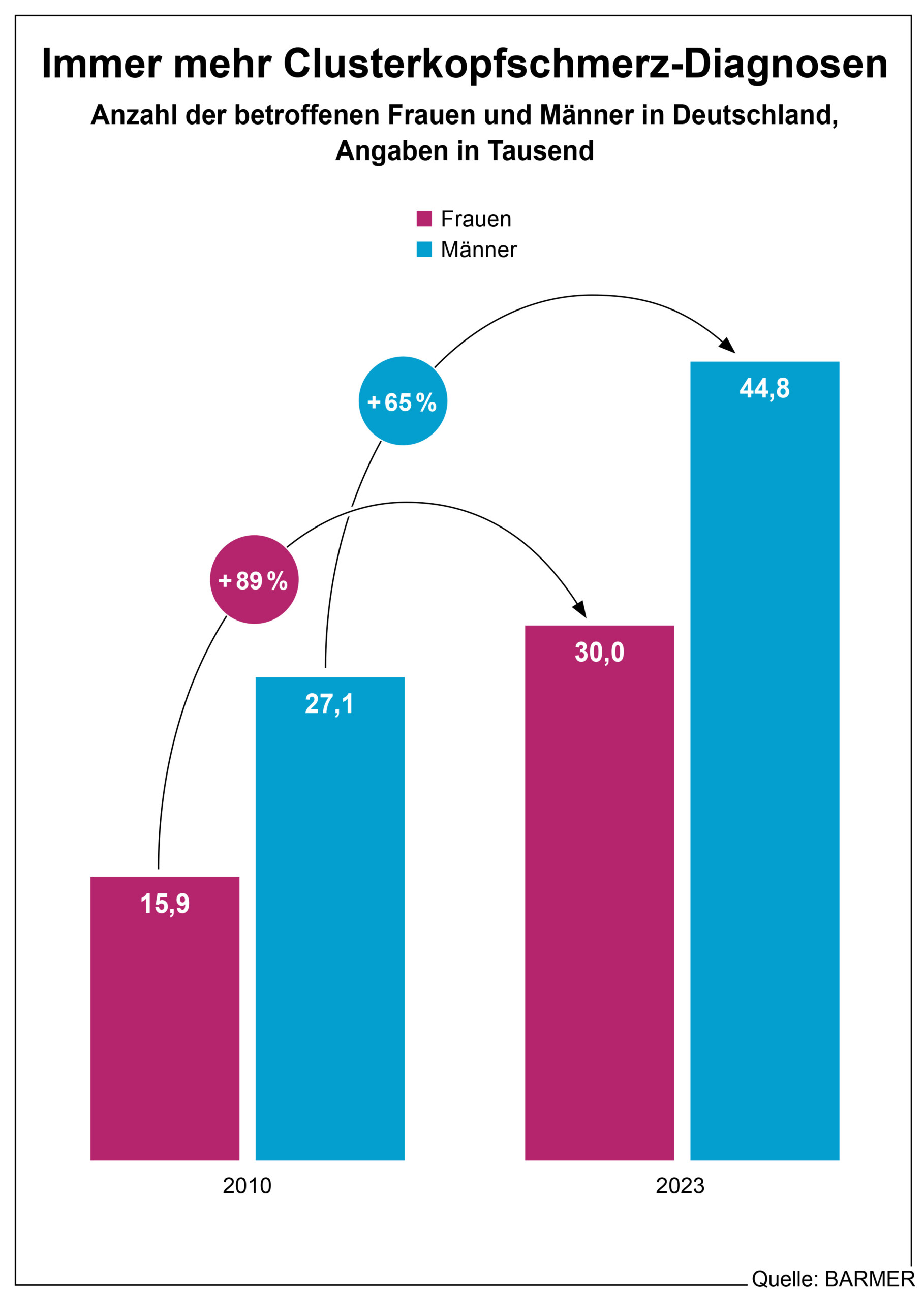
Berlin, August 7, 2025 – An increasing number of people in Germany are being diagnosed with cluster headaches. This condition is characterized by extremely severe, one-sided attacks of pain at night, affecting the temple and eye. It primarily affects men, but women can also suffer from this third most common type of headache after migraines and tension headaches. This is according to a recent analysis by the BARMER Institute for Health Systems Research (bifg). While around 43,000 people were diagnosed with cluster headaches in 2010, this number had risen to 74,800 by 2023. This represents an increase of 74 percent. The number of cases among men increased from approximately 27,100 to nearly 44,800, and among women from just over 15,900 to around 30,000. “Cluster headaches were long under-recognized and are now receiving greater attention. This is a good thing. After all, these extremely painful attacks not only disrupt sufferers' sleep but also severely restrict their overall quality of life. Appropriate medical care is therefore urgently needed,” says Prof. Dr. Christoph Straub, CEO of BARMER. Individualized treatment plans are required, which are best developed in collaboration with specialists at headache centers. Conventional headache medications are often ineffective for cluster headaches, and inhaled oxygen can sometimes stop an attack.
Middle-aged individuals are particularly affected.
According to a BARMER analysis, cluster headaches primarily affect people between the ages of 40 and 69. Between 2010 and 2023, the number of cases in this group rose from nearly 26,700 to around 47,700 diagnoses. "Cluster headaches are devastating because they often begin at night, disrupt sleep, and can occur in attacks lasting several hours. This is all the more problematic when there is no opportunity for recovery during the day afterward," says Straub.
Significant regional differences
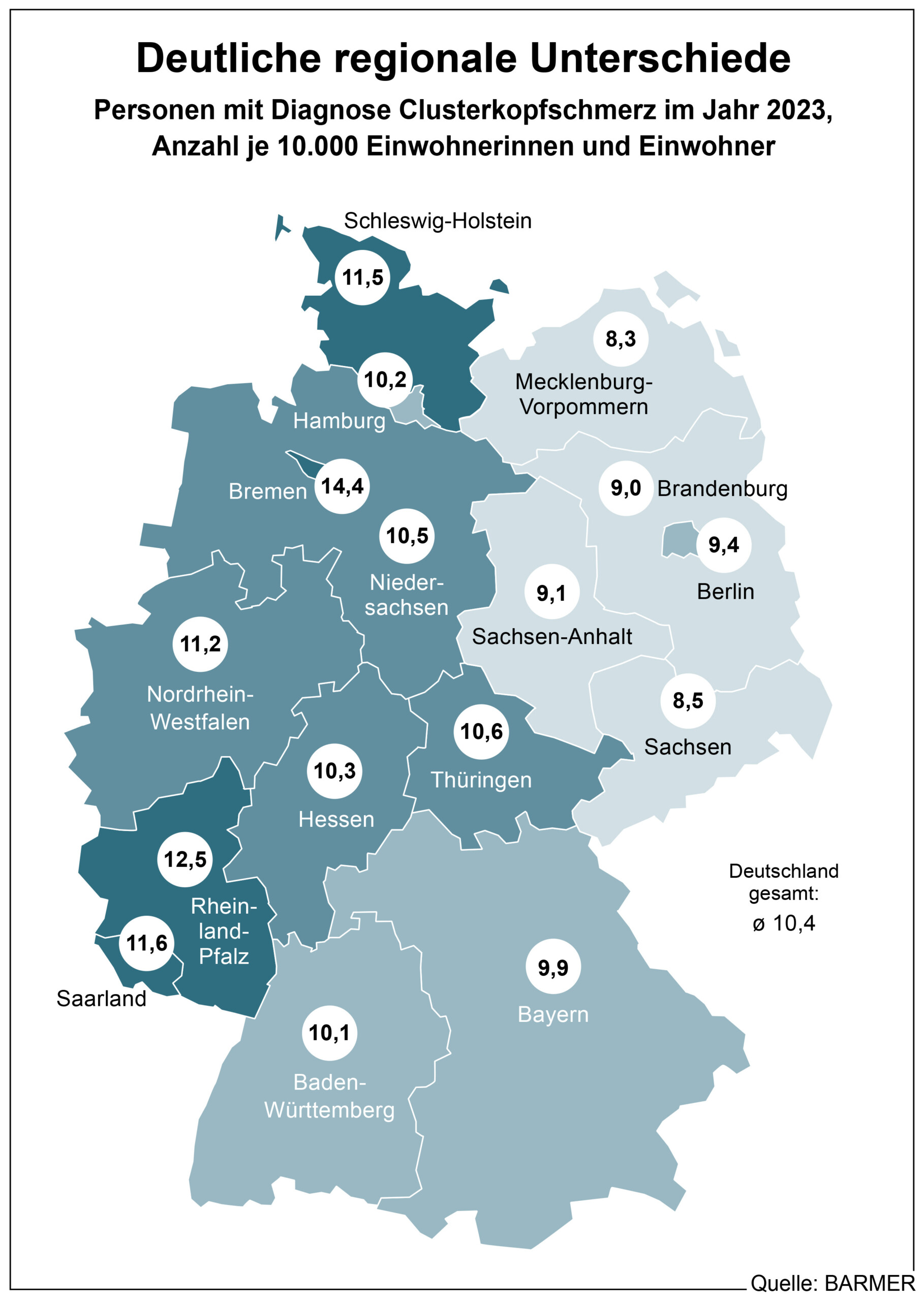
As the BARMER analysis further reveals, there are clear regional differences in the prevalence of cluster headaches. The diagnosis was most frequent in Bremen and Rhineland-Palatinate in 2023, with 14.4 and 12.5 affected individuals per 10,000 people respectively, and least frequent in Mecklenburg-Western Pomerania and Saxony, with 8.3 and 8.5 per 10,000 people respectively.
In 2010, around 1,800 people in Schleswig-Holstein suffered from cluster headaches; by 2023, this number had risen to over 3,000 – an increase of 67 percent. " Cluster headaches were long underestimated, but are now rightly coming into focus. And rightly so. After all, these extremely painful attacks not only disrupt sleep but also significantly impair quality of life. Tailored medical care is urgently needed," says Dr. Bernd Hillebrandt, Regional Director of Barmer in Schleswig-Holstein. Individualized treatment plans, ideally developed with specialists in headache centers, are essential. While conventional headache medications are largely ineffective, oxygen inhalation can sometimes bring an attack to an end.
Mostly middle-aged people are affected
According to a Barmer cluster primarily affect people between the ages of 40 and 69. In this age group, the number of cases nationwide increased by 78.6 percent between 2010 and 2023. " Cluster headaches are devastating because they often begin at night, disrupt sleep, and can occur in attacks lasting several hours. This is particularly problematic when there is no opportunity for recovery during the day," says Hillebrandt.
"Excruciating pain with suicidal thoughts" – New studies from the Kiel Pain Clinic reveal the true face of cluster headaches
Cluster headaches are considered one of the most excruciating forms of pain. Two recent studies from the Kiel Pain Clinic now impressively demonstrate that the condition is even more severe and diverse than previously thought – and drives many sufferers to the brink of despair.
A large-scale study of 825 patients demonstrates that the symptoms extend far beyond the currently accepted diagnostic criteria. Not only do attacks with extremely severe pain occur, but many also experience persistent pain between attacks . Furthermore, the side or location of the pain changes in some patients—factors that have not yet been considered in the official diagnostic criteria. "Overly restrictive criteria lead to patients being diagnosed and treated too late," the authors warn. Psychological comorbidities such as depression, anxiety, and sleep disorders are also common and further exacerbate the suffering (Göbel CH et al., Pain Ther . 2021;10(2):1121–1137).
The results of a second study involving 207 hospitalized patients were even more dramatic. More than 70% had been suffering from cluster headaches for more than five years, and over three-quarters experienced at least three attacks per day—often at night—leading to extreme exhaustion and inability to work. Almost all patients exhibited severe limitations in their quality of life. Particularly alarming: Over 40% reported suicidal thoughts. “Cluster headaches not only destroy the lives of those affected, they directly threaten them,” the researchers concluded (Göbel CH et al., Pain Ther . 2025;14:753–767).
Cluster headache is more than "just" a headache. The condition exhibits a wide range of clinical presentations and causes an almost unimaginable psychosocial burden. New studies make it clear: adequate care must urgently address the medical, psychological, and social consequences – so that those affected are no longer left unrecognized, inadequately treated, and alone with their suffering. "Cluster headache is excruciating. Many sufferers experience daily pain so unbearable that it can lead to suicidal thoughts. Our research shows that this condition destroys lives if it is not recognized and comprehensively treated in time," summarizes Prof. Dr. Hartmut Göbel, Chief Physician of the Kiel Pain Clinic, regarding the new study results.
Sources:
https://link.springer.com/article/10.1007/s40122-025-00715-9
https://link.springer.com/article/10.1007/s40122-021-00267-8
Recognizing and effectively treating cluster headaches


Leave a comment