




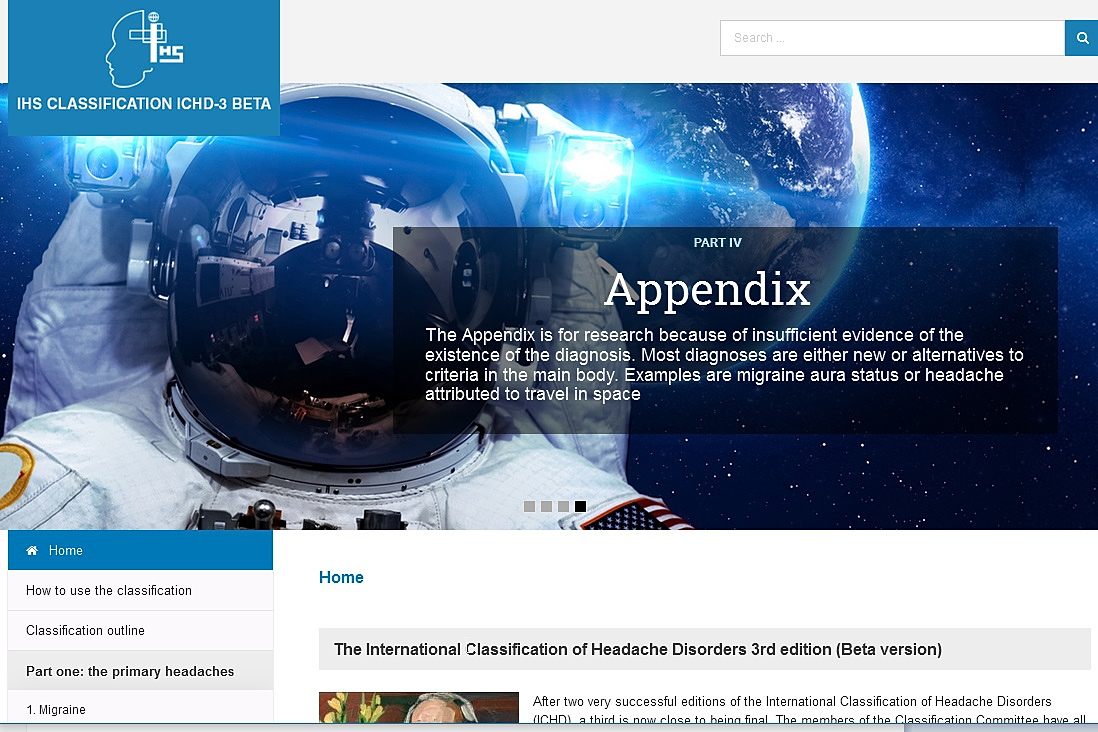
Like ICHD-2 , ICHD-3 beta, , is now also available in digital form. The digital ICHD-3 beta makes it much easier to understand the structure and content of the current classification. The slider clearly illustrates the three main groups and the appendix, which are listed in the main menu. The respective diagnoses can be selected from the text area after choosing the main heading. By working with the digital ICHD-3 beta, one can quickly become familiar with the classification text and its structure. There is no need to memorize the individual diagnostic criteria. The text, the menu, and the search function allow for quick answers to specific questions in clinical practice. The website provides rapid access to all information related to the International Classification of Headache Disorders, thus significantly facilitating its practical application in clinical settings and research.
Since the ICHD-3 beta version is still in the testing phase, the digital version will initially only be available in English. Currently available translations can be viewed in the download area. After the classification is finalized, various translations will be gradually integrated digitally.
The information on the classification and diagnosis of headaches is supplemented by original documents and accompanying materials, including lecture presentations and videos. The digital library on the classification and diagnosis of headaches will be continuously expanded.
The first edition of the International Classification of Headache Disorders (ICHD-1) was published in 1988. The first website to go online was launched almost simultaneously in 1990. While ICHD-1 was not yet available digitally, the first website for ICHD-2 became accessible worldwide in 2006. In recent years, there has been significant progress in the use of digital media in medicine. The use of mobile smartphones and tablets is now standard practice in all areas of medicine. Many different operating systems and displays are available. For the digital ICHD-3 beta, we have chosen a platform that automatically adapts to and is prepared for various devices and displays. We opted against separate apps on different platforms, as this would reduce practicality. Furthermore, the primarily text-based content is less suitable for app development. The digital ICHD-3 beta adapts responsively to different displays and platforms. The web address can be added directly to the home screen of the respective device. It can then be accessed and used just like a native app. The links explain how to add the digital ICHD-3 beta to the home screen iOS or Android
My sincere thanks go to Prof. Jes Olesen, Chair of the International Headache Classification Committee, and the committee members for entrusting me with the task of developing the digital version. I also thank the members of the ICHD-3 Website Committee who contributed to the creation of this digital version.
The new online service of the International Classification of Headache Disorders can be accessed at https://www.ichd-3.org/ .
Prof. Hartmut Göbel,
Chairman ICHD-3 Website Committee
.


Leave a comment