




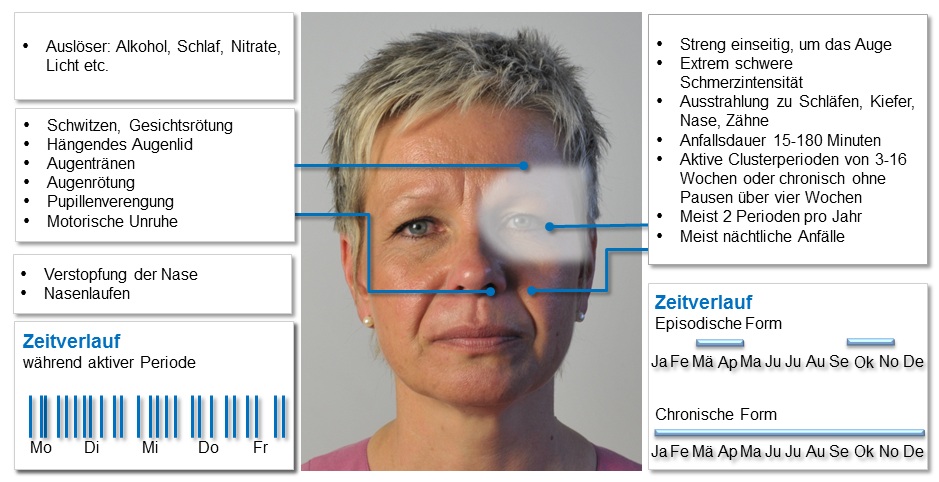
Spring is generally associated with positive feelings. However, there are people who view this season with great concern: those who suffer from cluster headaches and their families. Episodic cluster headaches are particularly likely to break out now with a new period, often lasting for weeks. The day after the start of spring – March 21st – has therefore been declared Cluster Headache Day.
Spring officially begins when the sun is directly overhead at the equator. Everything is precisely aligned: On this day, the sun rises exactly in the east, is due south at midday, and sets exactly in the west. The length of day and night are also exactly the same at the beginning of spring.
Just as migraines seem to know when the weekend is, occurring most frequently on Saturdays and Sundays, cluster headaches seem to know when spring begins. You can find information about cluster headaches under Cluster Headache Knowledge and in the video below. Wolfgang Q. and his wife Kathrin tell you what it means to suffer from cluster headaches.
Nameless pain, suicidal headache
Wolfgang Q. (39), electrician, and his wife Kathrin. Diagnosis: cluster headaches for twenty years
Kathrin: Before our wedding a year ago, I had already witnessed several cluster attacks my husband had, but the last painful phase was worse than anything before. The attacks came up to eight times within 24 hours, mostly at night. I hardly recognized him because his whole personality changed. He became very aggressive, like an animal in a cage, pacing restlessly. I was incredibly frightened! He never attacked me, but he pushed me away and wanted to be left alone. Even the cats noticed and hid. I wasn't afraid of him, but I was afraid for him. Sometimes he cried a lot, too.
Wolfgang: Yes, it was truly hell. When the cluster headaches started about twenty years ago, I obviously didn't know what was going on. The pain was in my left temple, especially in dry, heated air, and lasted between thirty and sixty minutes each time. During the attacks, which occurred during the workday, I would quickly run outside. Somehow, I always managed to do it without being noticed, for example, by taking fewer breaks or not recording the occasional overtime hour. I tried to keep my cool, but once I lost it, I became very, very angry, and unfortunately, my wife felt the brunt of it…
Kathrin: I begged you to go to the doctor!
Wolfgang: I'd already been through all that! For example, the ear, nose, and throat specialist. He operated on my nasal septum and turbinates, and after that, things were quiet for a while. But then it all started again. I became a huge Thomapyrin fan, and over the years, my pill consumption financed at least one luxury car for the company. Today I know that regular painkillers don't help, but back then I popped a whole handful. When the attack is over, you think the medication worked and take it again next time. Besides, I instinctively did something that nowadays costs a fortune to get prescribed: oxygen therapy. I would go out onto the balcony at night, rain or shine, and just breathe in, concentrating completely on my breathing.
Kathrin: One Sunday we drove to the Baltic Sea, and on the way back you had this attack. You just pulled up to a bus stop on this busy main road and jumped out of the car. I was sitting there and immediately turned on the hazard lights. I was terrified you might throw yourself in front of the next bus!
Wolfgang: I just couldn't go on up there on the country road any longer. It was blazing sunshine, and the heat is awful. I just wanted to get into the shade!
Kathrin: Another time you almost beat up a police officer…
Wolfgang: We were driving along while half the city was closed off due to a major event. When the attack came, I pulled over somewhere along the side of the road where I wouldn't be blocking anyone. No sooner had I stopped than a policeman, like Django, came towards us. I was about to attack him, but I pulled myself together and drove on. At the next intersection, I stopped again.
Kathrin: You turned off the engine and just walked away. It was awful! I felt so alone and helpless, and I swore to myself I'd never ride with you again while I was in pain. I don't want any trouble with the police!
Wolfgang: The policeman wasn't actually that bad.
Kathrin: But you were so aggressive!
Wolfgang: I just wanted to escape the sun and find some shade. It was a relief for me, but you felt let down.
Kathrin: I just had no strength left. You wouldn't know it to look at me now, but back then I looked like death warmed over. I couldn't sleep at night, I found no understanding at work, I had to go away on business trips, and then I cried at home. It was all so awful! At some point, I thought: that's it, I can't take this anymore! I knew these couldn't be normal headaches. So I went from one bookstore to another, reading for hours, always books about migraines. Until I came across the word "cluster." The book described the symptoms: the watery eye and runny nose, and that restless feeling. I thought: that fits, and I went to see my internist about it…
Wolfgang: …who referred me to a specialist. For the first time, I received a medication that actually helped. I still had four to five attacks a night, but then I would briefly turn on the light, give myself an injection, and fall back asleep. That was a huge improvement compared to what it had been like before.
Kathrin: I then found contact with the self-help group on the internet, and they arranged an appointment for us at the pain clinic within twenty-four hours, where you were given this long-term medication…
Wolfgang: …which has kept me pain-free for a month and a half now. The worst phase before that lasted seven months. You can imagine what that means for your social life! You don't want to make any plans anymore and you don't get invited around because your acquaintances don't know how to deal with it. Many people want to help and come up with the craziest things. Reyki or distance healing by fax, laying on of hands, or tarot card readings… It's not that you wouldn't try anything, but it always depends on who makes the suggestions. In the support group, we share our experiences and try the craziest things. The group has created handouts for family, friends, and bosses, briefly explaining the illness in a way that's appropriate for each person. That's very helpful.
For the past six months, I've officially been 30% disabled. I've tried talking to my employer about my condition, but he doesn't want to hear about it. The problem is, you can't tell by looking at me. I take my packet of injections, which I always carry with me, to the bathroom, and then I'm fine again. It works within three minutes.
Kathrin: The only positive thing about this misery is that I didn't have much time to think about my own illness. I'd rather go through the cancer surgery again, with all its complications, than what I had to experience with you. Seeing my beloved partner suffer—that was absolutely terrible for me. I've never cried as much as I did in those seven months. I desperately wanted to get away, but I couldn't. I have to be completely honest: during that time, I would have loved to work overtime because I knew I was going to be right back in that grind. The worst part was the night attacks. Now we're enjoying the pain-free time, but I'm terrified of the next attack.
Wolfgang: I know this is a huge burden for you. I wouldn't have made it through without you, and I wish more family members would come to the group meetings. Then you could talk to other affected individuals.
Kathrin: Of course, it's best to talk about it in a group. Other people don't want to hear about it. I tried it once with a colleague I'm very close to, but she shut me out. My husband and I talk about it a lot and try to be enough for each other.
Wolfgang: During the attacks, I sometimes thought about our love and tried to comfort myself with it. I no longer have any desire to jump off a balcony, and I owe that entirely to you. As long as I lived alone, the despair was greater, as was the constant worrying about what I could have done wrong to deserve such punishment. When you sit on the bed at night with this pain, the strangest thoughts come: "Why did I have this particular illness out of all the imaginable ones? Am I being punished for breaking off contact with my parents years ago?" You help me. With you, I feel at home. You mean everything to me. Getting through this terrible year has made me stronger. I'm not afraid of the next cluster headache phase either, because now I have these injections that help me.
Kathrin: For me it's different. The memory of the painful period is still very vivid, and I'm terrified of the next one.
Wolfgang: You're afraid the illness will become chronic. Then there's hardly any help, because the painkillers I take aren't for long-term use.
Kathrin: To be honest, I doubt you've gotten any stronger. Okay, you have the injections that help you now, but you're taking too many. Who knows what they're doing to your body, and whether they'll stop working at some point? I'm still so tense inside, and I wait every day for it to start again. I still can't believe that you'll be okay for any length of time. (Tears well up in her eyes.) It's so awful when your beloved husband is so ill! I'm grateful that things have been quiet for weeks now, but I'm always afraid it will start again!


I can confirm everything described here from my own experience. When my cluster headaches really started, I went to countless doctors: ENT specialist, ophthalmologist, dentist, and even had an MRI at a radiologist. All without any results. My family doctor finally referred me to a neurologist. There, I was diagnosed with a condition very similar to cluster headaches. However, the medications I was given sometimes made the attacks, which I was now experiencing up to 10 times a day, much worse. Everyone around me, both at work and in my personal life, just watched helplessly when an attack left me completely unable to work. It wasn't until three years later that I sought help at the pain clinic in Kiel. There, they immediately diagnosed me with chronic cluster headaches. They prescribed different medications and oxygen therapy right away. And what can I say? The attacks decreased noticeably. However, they didn't disappear completely. I was in Kiel in 2009. I hardly ever had an attack-free period, but considering that I previously had between 8 and 12 attacks a day lasting 30 to 90 minutes, and then another 2 per quarter, it was a tremendous improvement in my quality of life.
Then came the 2014 FIFA World Cup. A time that completely changed my life. Needless to say, the World Cup was very emotionally charged. But the fact is, none of the medications worked. Not the preventative ones, not the oxygen, and not the emergency medication. Because of this, I unfortunately didn't get to experience much of the World Cup. During this time, I experienced attacks at their peak, with an intensity I had never known before. Once, my partner had to pull me out of the window because I wanted to jump. Another time, I became so nauseous during an attack that I vomited.
About 14 days after the World Cup, it was all over. By then, I had completely stopped taking the medication. And with the oxygen, I noticed that it only suppressed the pain for the duration of the inhalation. After 15 minutes, however, the pain returned unabated. And each attack of pain threw me further and further off balance. And suddenly, after I contacted the clinic in Kiel again, the attacks stopped.
All of this happened almost two years ago. I no longer take any medication or oxygen. But I am free. Free from attacks. I only very rarely experience a brief episode. These disappear after five minutes at the most.
I have no idea what happened. The only certainty is that I have been living without a full-blown attack for almost two years. And that is a life I wish for everyone.
However, the World Cup, or rather the attacks I had during that time, have left their mark. As with every attack, my entire left side of my face was affected. My left eye was also swollen shut each time. I think the attacks were so severe that my eye never fully recovered. I can't open that eye properly anymore. To outsiders, it looks like I've had a stroke.
Now it's all starting again. The ophthalmologist is referring me to a neurologist. And he wants to get to the bottom of it and wants an MRI of my brain. The appointment is in a few days. I'm afraid of the results.
At this point, I truly wish Wolfgang a speedy recovery. I wish Kathrin the strength she needs and the understanding that Wolfgang is at least as helpless as she is. The difference being that Wolfgang is in unbearable pain.
With kind regards to all fellow sufferers and their environment
Lars Baer