


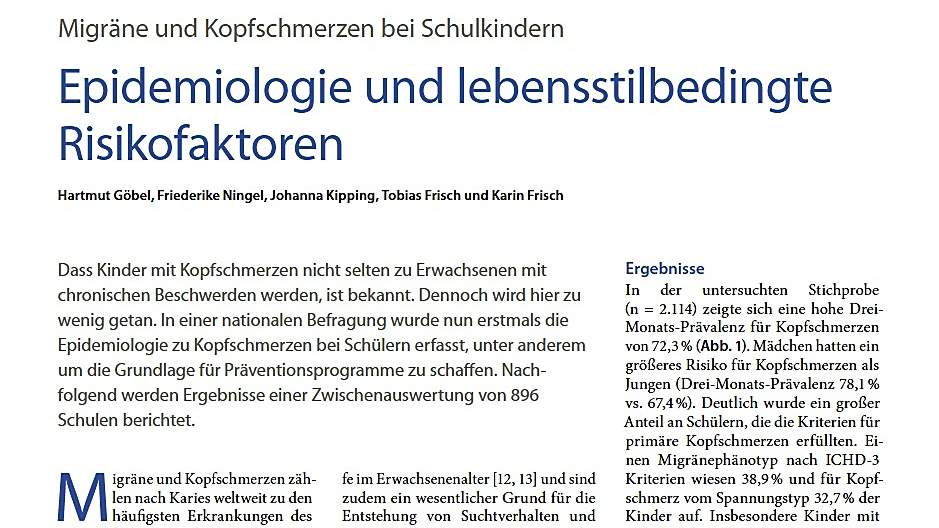

Migraine and headaches are among the most common human diseases worldwide, second only to dental caries (Steiner et al. 2013). Regarding oral health, epidemiological analyses and the resulting intensive prevention programs in industrialized countries have led to a significant decline in dental caries (Robert Koch Institute 2009). However, migraine and headaches in schoolchildren have received little attention until recently (Ellert et al. 2007). Headache disorders can have serious consequences for physical and mental health. They severely limit academic success, performance, and life chances of those affected (Hershey et al. 2005). Furthermore, migraine and headaches in children are associated with a number of comorbidities such as asthma, allergies, sleep disorders (Isik et al. 2007, Isik et al. 2009), as well as anxiety and depression (Lampl et al. 2016, O'Brien et al. 2016). Migraines and headaches are among the most common pain experiences not only in adults but also in children and adolescents. More than 50 years ago, the work of Bille (Bille 1962, Bille 1997) drew attention to the significance of headaches in children. Little has changed since then. Headaches during school age are associated with an increased risk of chronic headaches in adulthood (Brna et al. 2005). They lead to a higher risk of chronicity (Monastero et al. 2006). Furthermore, the occurrence of other organic and mental illnesses is also more likely (Arruda et al. 2006). Headaches are also a major contributing factor to the development of addictive behavior and substance abuse (Göbel 2012). Therefore, headache prevention is of crucial individual, societal, and health-economic importance. To assess the baseline epidemiological situation nationally, epidemiological data on headaches in 7th-grade students were collected for the first time throughout Germany.
You can download the full article here:
Migraine and headaches in school children: epidemiology and lifestyle-related risk factors
literature
- Anttila P1, Metsähonkala L, Sillanpää M (2006) Long-term trends in the incidence of headache in Finnish schoolchildren. Pediatrics. Jun, 117(6):e1197-1201
- Monastero R, Camarda C, Pipia C, Camarda R (2006): Prognosis of migraine headaches in adolescents: a 10-year follow-up study. Neurology 67: 1353-1356
- Bille B. (1962): Migraine in schoolchildren. Acta Paediatr Suppl 51: 135-151
- Bille B. (1997): A 40-year follow-up of school children with migraine. Cephalalgia 17(4) 488-491
- Brna P, Dooley J, Gordon K, Dewan T (2005): The prognosis of childhood headache. Arch Pediatr Adolesc Med; 159(12): 1157–60
- Ellert U, Neuhauser H, Roth-Isigkeit A (2007): Pain in children and adolescents in Germany: Prevalence and use of medical services. Results of the German Health Interview and Examination Survey for Children and Adolescents (KiGGS). Bundesgesundheitsblatt Gesundheitsforschung Gesundheitsschutz; 50: 711-717
- Gießelmann K, Lenzen-Schulte M: Headache prevention in children: breakfast, sleep and more leisure time. Dtsch Arztebl 2017; 114(41): A-1869 / B-1586 / C-1552
- Göbel H (2012): Headaches. Springer Medizin Verlag, Berlin, Heidelberg, New York, London, Paris, Tokyo, Hong Kong, Barcelona, Budapest
- Hershey A (2005): What is the Impact, Prevalence, Disability and Quality of Life of Pediatric Headache? Current Pain and Headache Reports 9: 341-344
- Isik U, Ersu RH, Ay P, Save D, Aman AR, Karakoc F et al. (2007): Prevalence of headache and its association with sleep disorders in children. Pediatrics Neurol.; 36:146-151
- Isik U, Topuzoglu A, Ay P, Ersu RH, Arman, AR, Önsuz MF, Karavus M, Dagli E (2009): The Prevalence of Headache and its Association with Socioeconomic Status among Schoolchildren in Istanbul, Turkey. Headache 49, 697-703
- Lampl C, Thomas H, Tassorelli C, Katsarava Z, Lainez J, Lanteri-Minet M, Rastenyte D, Ruiz de la Torre E, Stovner L, Andree C, Steiner T (2016): Headache, depression and anxiety: as-sociations in the Eurolight project. J Headache Pain 17:59
- Monastero R, Camarda C, Pipia C, Camarda R (2006): Prognosis of migraine headaches in adolescents: a 10-year follow-up study. Neurology 67: 1353-1356
- O`Brien H, Slater S (2016): Comorbid Psychological Conditions in Pediatric Headache. Semin Pediatr Neurol 23:68-70
- Robert Koch Institute (ed.) (2009) Oral health. Federal Health Reporting. Issue 47. RKI, Berlin
- Steiner TJ, Stovner LJ, Birbeck GL: Migraine: the seventh disabler. Cephalalgia 2013; 33:289-90.
- Gießelmann K, Lenzen-Schulte M: Headache prevention in children: breakfast, sleep and more leisure time. Dtsch Arztebl 2017; 114(41): A-1869 / B-1586 / C-1552


Leave a comment