


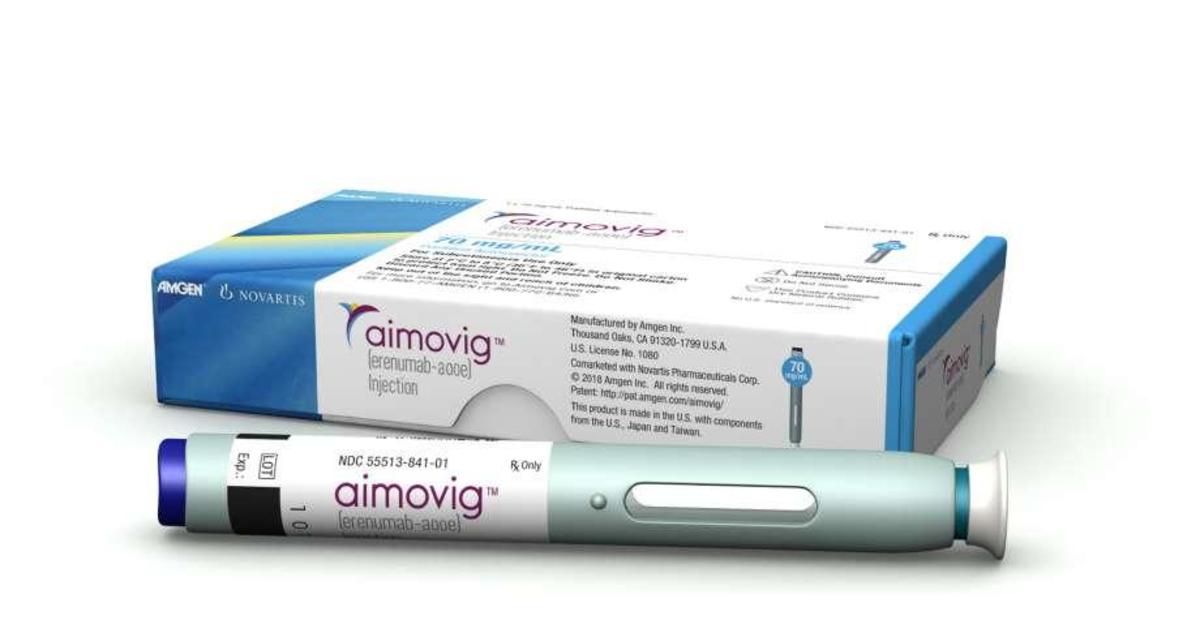
17.5.2018. On May 17, 2018, the U.S. Food and Drug Administration (FDA) approved Aimovig (erenumab-AOOE) for the preventive treatment of migraine in adults. The treatment is administered via a self-injection of the drug under the skin once a month. Aimovig is the first FDA-approved preventive migraine medication in a new class of drugs designed to prevent migraines. These drugs work by inhibiting the activity of calcitonin gene-related peptide (CGRP), a molecule involved in the development of migraine attacks. "Aimovig provides migraine patients with a new option to reduce the number of migraine days per month. We need new treatment options for this painful and often disabling condition," said Erik Bastings, Division Director of Neurological Products at the U.S. Food and Drug Administration.
Migraine occurs in over 45 different subtypes. The most common form is migraine without aura. The headaches last from 4 to 72 hours. The headache is characterized by a throbbing, pulsating pain. Physical activity intensifies the pain, requiring patients to rest in bed. The attacks are accompanied by nausea and vomiting, as well as sensitivity to noise and light. In approximately 10-30% of patients, neurological symptoms, known as auras, precede the headache phase. The most common of these are visual disturbances with zigzag lines that gradually spread across the field of vision and impair visual acuity. Other symptoms include difficulty finding words, tingling sensations, paralysis, and altered consciousness. Complications of migraine include migrainous stroke and epileptic seizures triggered by a migraine attack. Migraine occurs approximately three times more often in women than in men. Within a year, approximately 10-14% of the population is affected. Approximately 1-2% of the population suffers from chronic migraine. This means that headache attacks occur on more than 15 days per month.
The efficacy of Aimovig for the preventive treatment of migraine was investigated in three clinical trials. The first study included 955 participants and analyzed the drug's effect in the prevention of episodic migraine, comparing the efficacy of Aimovig to that of a placebo. Over a six-month period, patients treated with Aimovig experienced, on average, one to two fewer migraine days per month compared to those treated with placebo. In a second study, 577 patients with episodic migraine were examined, and the efficacy of Aimovig and placebo was analyzed. Over a period of three months, patients treated with Aimovig experienced, on average, one fewer migraine day compared to those treated with placebo. In a third study, 667 patients with chronic migraine were examined, and the efficacy of Aimovig was compared to that of placebo. In this 3-month study, patients treated with Aimovig experienced an average of 2.5 fewer migraine days per month compared to patients receiving a placebo. The most frequently observed side effects were injection site pain, upper respiratory infections, and nausea.
"This new drug opens a new era in migraine treatment. Its approval is good news for patients suffering from the most severe forms of these headaches. It is the first drug specifically developed for the prevention of episodic and chronic migraines. It targets the mechanisms underlying migraine development, inhibiting the inflammatory processes responsible for migraine headaches. Unlike any other preventative medication currently available, this new immunotherapy is the first to be specifically developed for migraine prevention. A slow dose titration due to intolerances and side effects is not necessary. The onset of action is expected quickly, initially within a few days, whereas with conventional preventative medications, this often takes weeks or even months. Side effects of previous migraine preventatives, such as weight gain, mood swings, fatigue, reduced energy, or drowsiness, do not occur. This is in contrast to previous medications, which were often discontinued after a short time due to such side effects." Patients treated with this therapy tend to remain on it long-term due to its tolerability and efficacy. The data available so far show that it cannot be assumed that the new immunotherapy will eliminate migraines and allow patients to live as they please. On average, the number of headache days is reduced by approximately 1-3 days per month. The efficacy is therefore, on average, similar to that of existing preventative medications. "Particular advantages are the rapid onset of action, the tolerability, and the response of patients who have not experienced any effect from other treatments," commented Prof. Dr. Hartmut Göbel, Head Physician of the Kiel Pain Clinic, on the new approval.
The new drug is expected to be available in the United States within the next week. So far, the drug has only been studied over relatively short periods. Side effects observed during these studies were no more frequent than those of a placebo. However, potential long-term side effects of the drug in treating migraines, which can last for years or even decades, remain unknown.
Approximately 2% of the world's population suffers from chronic migraine. The World Health Organization classifies migraine as the third most common disease worldwide, and it is among the most prevalent chronic illnesses. Headaches rank third among the most debilitating diseases. Currently available preventative medications were not specifically developed for migraine treatment. The preventative effect of these drugs was recognized as a secondary benefit, and their efficacy was subsequently investigated in clinical trials. Their effectiveness is limited, and numerous undesirable side effects occur. As a result, more than 80% of treated patients discontinue their medication after just one year, either due to lack of efficacy or side effects. Over the years, patients try out the available medications one after the other or combine them. Some patients find the side effects of the currently available medications more pronounced than the migraine itself. Due to the unpredictability of attacks, many migraine sufferers are unable to make plans, commitments, or appointments. They are also unable to pursue professional activities. Migraines are highly likely to be associated with psychological complications such as anxiety disorders, depression, and personality changes. The risk of high blood pressure, heart attack, and stroke is also significantly increased. Even children can experience severe migraine attacks. Recent studies show that the prevalence of migraines in childhood has risen sharply in recent decades.
The monthly cost of therapy in the United States is expected to be around $570. The new drug is anticipated to be available in Europe in the second half of the year. The exact wording of the approval and the definition of which patients will be eligible for reimbursement by health insurance companies are not yet known.
This new class of drugs is the result of over 30 years of research. In the 1980s, it was discovered that CGRP plays a crucial role in migraines. CGRP is a neurotransmitter that is essential for signal transmission in the nervous system and also plays a vital role in vascular regulation, particularly vasodilation. CGRP antibodies block its effects and can thus prevent the mechanisms that trigger migraine attacks. Partially blocking CGRP can prevent migraine attacks without disrupting normal nervous system function. Initial attempts to directly block CGRP were unsuccessful due to insufficient long-term tolerability. Consequently, antibodies were developed that target the cell surface of the CGRP molecule and inhibit its function. The half-life of these antibodies is more than four weeks. Therefore, treatment can be administered every month, thus maintaining the drug's effect over the long term. This is a form of immunotherapy, a passive immunization through the external delivery of antibodies. Since the body cannot produce these antibodies itself, they must be administered again every four weeks. Furthermore, drug development is underway in which the medication is administered via infusion in a doctor's office every three months.
Even though the new medication opens up new options for those affected, it shouldn't be expected that the migraine problem will be solved and that one can live as one pleases. Knowledge, information, behavioral adjustments, and a regular daily routine are crucial for the prevention and treatment of migraines. Migraine is a complex condition that, similar to the treatment of diabetes, high blood pressure, or asthma, requires a comprehensive treatment approach. Medication plays only a partial role in this. Analysis of the study results shows that the new class of drugs is not sufficiently effective in approximately 50% of treated patients. In the remaining patients, a reduction of migraine days per month of approximately 1-3 days is achieved. Therefore, a comprehensive treatment approach that includes behavior, knowledge, lifestyle adjustments, acute therapy, and medication is necessary.
Summary of the EMA recommendation on erenumab
US product information


Hello. I used to have 10-14 migraine attacks a month. On September 16, 2024, I went to the pain management unit, also for another condition, and since then (28,024 days) I haven't had an attack. An attack developed on the very same day I received the 140 mg injection, and it subsided immediately!
Many thanks to research and development. I have a new quality of life.
I learned about this new medication for the first time today; it's like a miracle! I've suffered from migraines since childhood and am now
62 years old. I'm immediately on board for the new migraine medication (aimovig). My sincere thanks to the research team and everyone involved. Karola Hötger Hegemann
It would be a blessing for me and all those affected.
I would like to thank the researchers.
Bärbel Paulus
I'm curious to see what my neurologist says about it
I'm curious to see how our health insurance companies react regarding cost coverage, requirements, etc.
In any case, it's another glimmer of hope in the pain management field, and we should already be very grateful to the entire research team and everyone involved.
I personally will be discussing this with my neurologist, Olaf Biewald.