




 The senior psychologist Anneke Nielson and the head physician of the Kiel Pain Clinic, Prof. Dr. med. Dipl.-Psych. Hartmut Göbel, have developed a new, contemporary version of progressive muscle relaxation for the treatment of children and adolescents.
The CD also includes a guided relaxation exercise. This method is favored by classic relaxation training programs for headaches, especially migraines, as it is the easiest to learn and has also proven to be the most effective.
The method is based on an active perception of tension and relaxation in the muscles and enables one to actively bring about the deepest possible relaxation in the body, but also in experience.
The CD provides a form of classic relaxation training specifically adapted for use by children and adolescents. The method was extensively clinically tested at the Kiel Pain Clinic with the participation of children and adolescents.
For children: How the procedure works
"Progressive muscle relaxation" is a word that sounds very complicated at first, but behind it lies a really simple method: "Progressive" means "progressive" and "muscle relaxation" is another word for "muscle relaxation", i.e., it is about "progressive muscle relaxation".
In this type of relaxation, individual important muscle groups of the body are progressively, i.e., gradually, relaxed. This is achieved by first tensing these muscle groups strongly for a brief moment and then completely relaxing them again.
You'll notice for yourself that the muscle tension is very quick, but the relaxation phase, until the muscles are completely relaxed again, takes longer – six to seven times as long! This is because all the muscle fibers first have to unwind and relax.
In total, six muscle groups are tensed and then relaxed in succession. I'll briefly explain what these exercises are so you can try them out and see how they work.
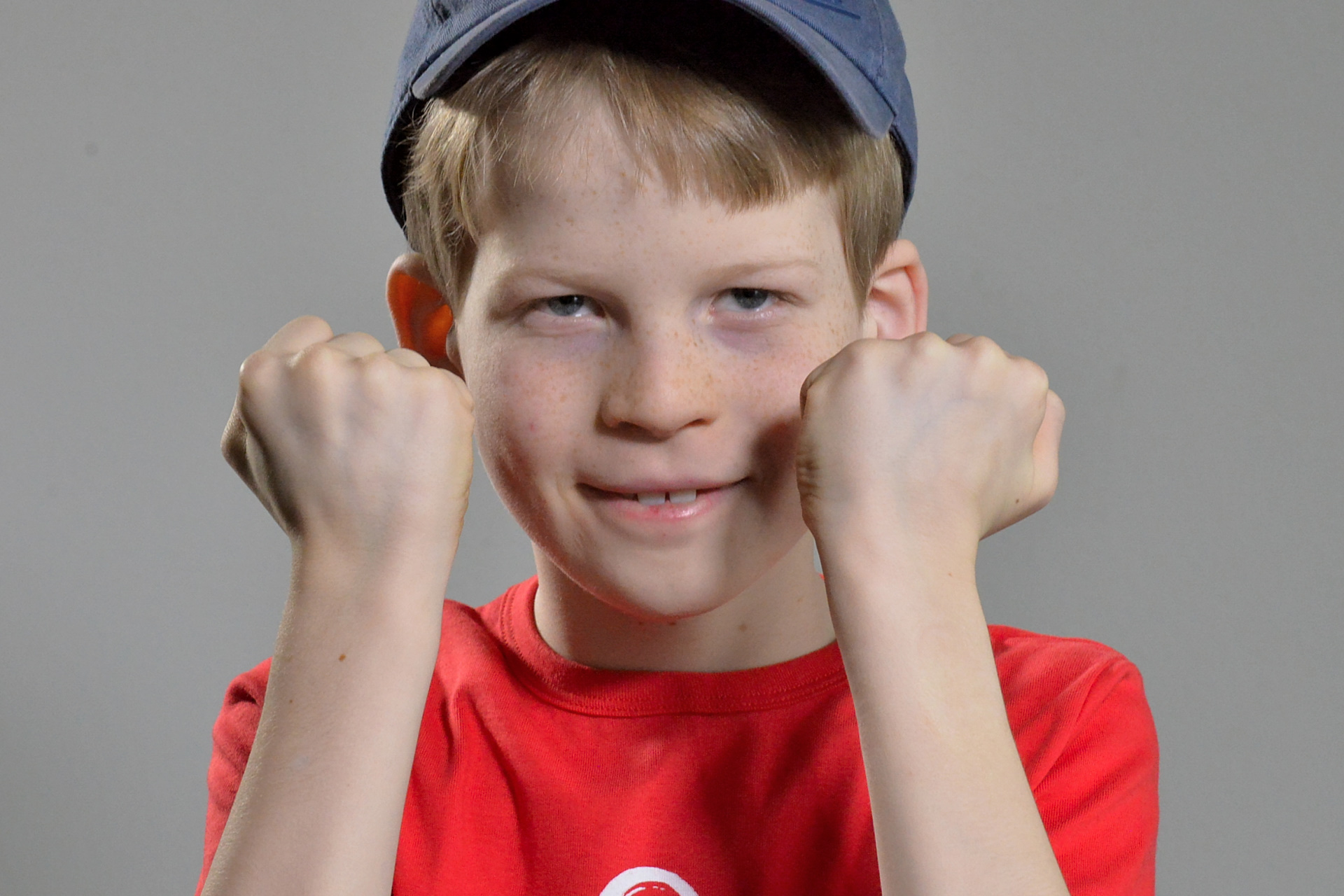
First comes the arm exercise : You tense the muscles in your arms by raising both arms, bending them, and making fists with your hands. You can imagine that you have a wet sponge in each hand and are squeezing it out. You'll notice how both arms are properly tensed.
Next comes the forehead exercise : You tense your forehead and the upper part of your cheeks by furrowing your brows as if you were annoyed, while simultaneously wrinkling your nose as if something smelled bad. Do you notice how this exercise creates tension in your face?
Thirdly, the lower part of your face : Clench your teeth tightly and at the same time pull the corners of your mouth wide towards both ears, like a broad grinning smiley face.
After the two face exercises comes the shoulder exercise : In this exercise, please raise your shoulders as high as possible and simultaneously pull your head in, as if you wanted to say "I have no idea!"
The so-called core exercise , that is, the exercise that affects the muscles of your upper body, goes like this: You take a deep breath and pull your stomach in very tightly. A bit like you're trying to close a pair of pants that are much too tight.
Finally comes the leg exercise : Press your heels firmly into the ground and simultaneously pull your toes up towards your face, as if you were braking with your feet while sledding.
That was all six exercises. You see, it's not difficult at all.
Here you can listen to audio samples:
Progressive muscle relaxation for children and adolescents
The Leisurely Cloud Spirit – A Relaxing Journey for Children
Contents:
- introduction
- How relaxation works
- Progressive muscle relaxation for children
- The Leisurely Cloud Spirit – A Mental Relaxation Journey for Children
Authors:
Anneke Nielson, M.Sc. Psychology and Psychological Psychotherapist, is the lead psychologist at the Kiel Pain Clinic. She has extensive experience in teaching children and adolescents relaxation techniques for the treatment of migraines, headaches, and other conditions.
Prof. Dr. med. Dipl.-Psych. Hartmut Göbel , specialist in neurology, pain therapy, psychotherapy, and holds a diploma in psychology, is the head physician of the Kiel Pain Clinic. His scientific research on the origins of pain and migraines has been recognized with numerous national and international awards.


Leave a comment