


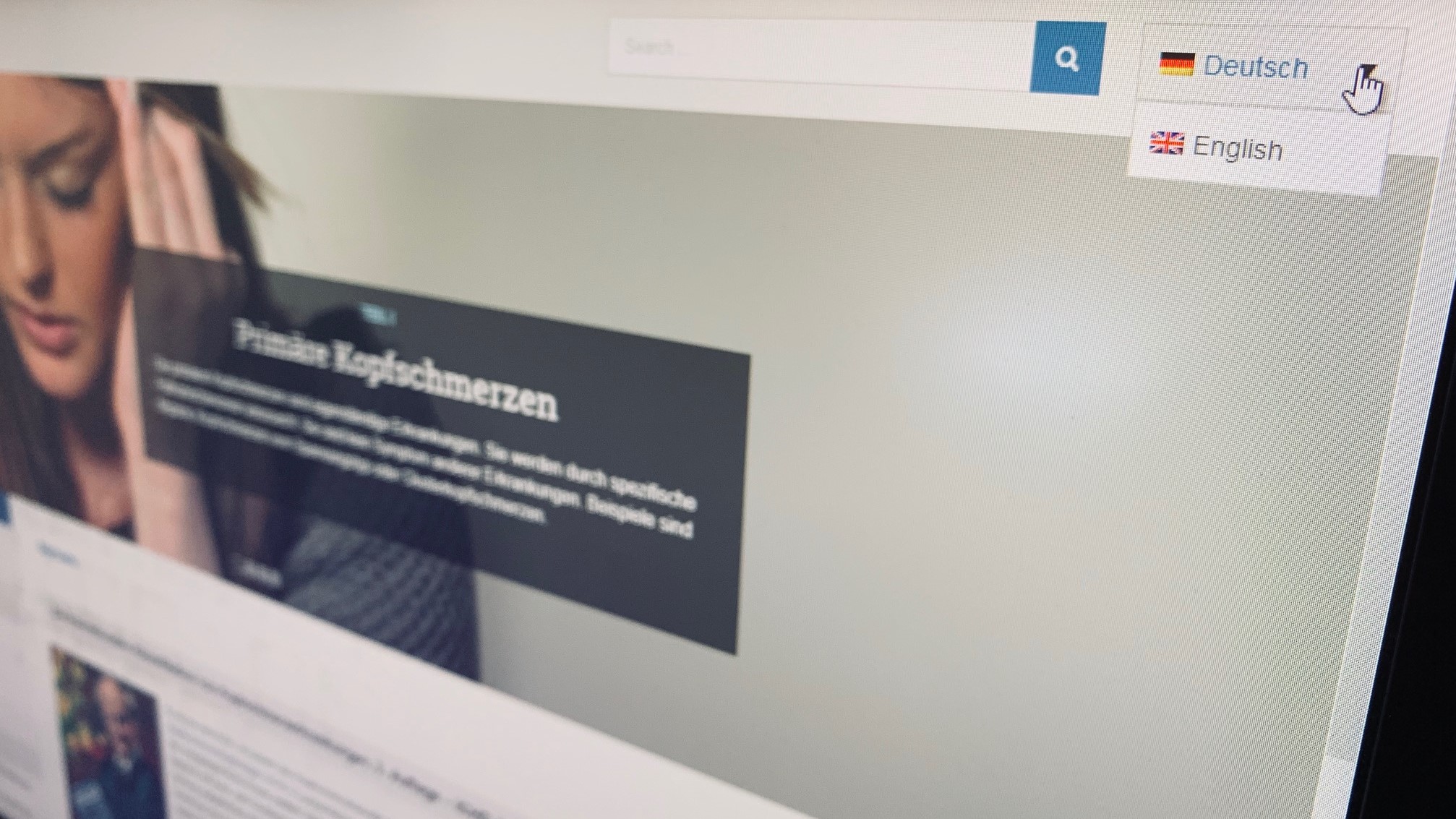


The third edition of the International Classification of Headache Disorders (ICHD-3) is now available digitally in German. The digital ICHD-3 makes it much easier to understand the structure and content of the current classification. Practical application in clinical care and research is thus easier than ever before. The three main groups and the appendix of the ICHD-3 organize the main menu. The respective diagnoses can be found and selected by clicking on the main heading in the text selection menu. The text, menu, and search function allow for quick answers to specific questions in clinical practice. The ICHD-3 website thus provides rapid access to all information of the international classification of headache disorders and facilitates modern care for headache disorders.
The ICHD-3 beta version and the ICHD-2 version are available online and can be viewed digitally for comparison purposes. Information on the classification and diagnosis of headaches is supplemented by relevant original documents and accompanying materials such as presentation templates and a media library. The digital media center for the classification and diagnosis of headaches will be continuously expanded.
The first computer was invented between 1936 and 1938, long before the development of an international headache classification began. The first edition of the International Classification of Headache Disorders ( was published in 1988. The first website to go online was launched almost simultaneously in 1990. While ICHD-1 was not yet available digitally, the first website for ICHD-2 accessible worldwide in 2006. In recent years, there has been significant progress in the use of digital media in medicine. The use of mobile smartphones and tablets is now standard practice in all areas of medicine. Many different operating systems and displays are available. For the digital ICHD-3, we have chosen a platform that automatically adapts to and is optimized for various devices and displays. The web address can be added directly to the home screen of the respective device. It can then be accessed and used like a native app. The links explain how to add the digital ICHD-3 beta to the home screen iOS or Android The website also offers a reading mode . A single click reformats the pages for easier reading. After loading the ICHD-3 website, you can activate the reading mode button in the top left corner of the address bar in the Safari browser, for example. A similar reading mode is also available for other modern browsers.
My sincere thanks go to Prof. Jes Olesen , Chair of the International Headache Classification Committee, and the committee members for entrusting us with the task of developing the digital version. I also extend my heartfelt thanks to Dr. Stefanie Förderreuther, President of the German Migraine and Headache Society, and Prof. Dr. Dr. Stefan Evers, Secretary General of the International Headache Society, for initiating the German translation of the ICHD-3. Finally, I thank the members of the ICHD-3 Website Committee who contributed to the creation of this digital version.
Prof. Hartmut Göbel,
Chairman of the
ICHD-3 Website Committee of the International Headache Society


A heartfelt thank you to the International Headache Society (IHS) for updating the differentiation criteria for the many types of headaches. The web version also brings clarity and transparency to us patients, which is important since we ourselves need to become experts on our condition. The fact that Professor Göbel implemented the web version for the International Headache Society, including an English version for the entire world, demonstrates its international significance. Congratulations!
Before my stay at the Kiel Pain Clinic, every developing migraine would turn into a severe attack, so intense that I didn't even need to differentiate between the different types, and this happened more than half the day. Migraine without aura, chronic migraine, medication-overuse headache.
After my inpatient stay at the pain clinic, my triptan use is no longer more than 10 days per month. That's a halving. Instead, I experience "mild" forms of migraine with nausea and moderate headaches on many days. With the classification criteria, I now know that either the criterion of unilateral severity or an increase due to physical exertion must be present to classify it as migraine; if a criterion is missing, it could be a probable migraine. This is
certainly not new to specialists, but it is for me, as I am experiencing new situations, and therefore helpful.
Previously, I had used Professor Göbel's "triptan threshold" selection criteria, which reflect this. I've been using this for six months and find it very helpful and practical. The "triptan threshold" is part of the Kiel Migraine App.