


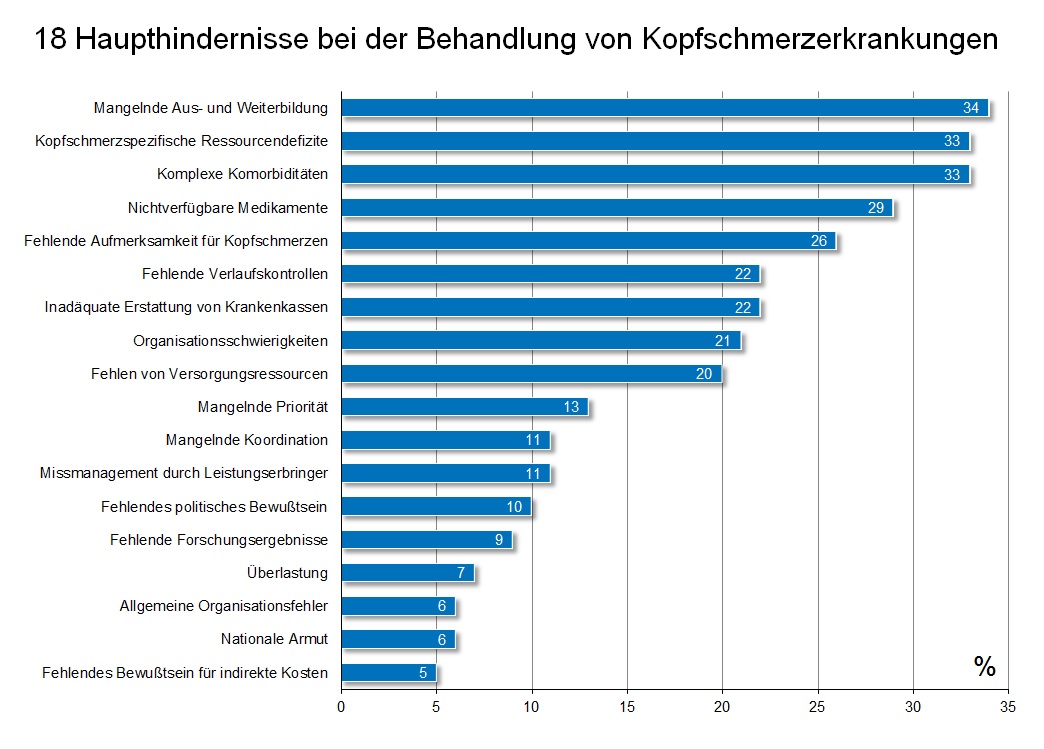
 The inadequate care for the common ailments of migraine and headaches does not primarily stem from a lack of scientific knowledge regarding the causes and treatment of headaches. A wide range of such knowledge is now readily available. Rather, the gaps in care are predominantly due to organizational deficiencies within the healthcare system and in the implementation of current knowledge . A recent analysis by the World Health Organization explicitly confirms this, identifying 18 major obstacles to the treatment of patients with headache disorders (see figure). Foremost among these is the lack of training and continuing education for physicians and therapists in the treatment of migraine and headache disorders. Consequently, the diagnostic diversity, the relevance to health policy, and modern treatment methods cannot be translated into practical care. Headache-specific resource deficits, a lack of attention to headaches, inadequate reimbursement by health insurance companies, organizational difficulties, a lack of care resources, insufficient prioritization, poor coordination, mismanagement, a lack of political awareness, overburdening, general organizational errors, and a lack of awareness of indirect costs are the main obstacles to the treatment of headache patients. Even the greatest efforts in scientific laboratories cannot overcome these major barriers to modern, efficient care. Rather, public awareness among health insurance companies and health policymakers, the lack of prioritization, and general coordination and organizational errors must be addressed in a focused manner to improve the treatment of patients with migraines and headaches. Professional training and continuing education for students, physicians, and therapists must be a top priority. Raising awareness of the scale of the problem, improving the availability and coordination of care, the organization and structuring of services, and improved reimbursement for headache therapy must become central points of attack for innovative, modern treatment of patients with headaches. This also includes the joint interaction of experts, professional associations, health policy and self-help groups.
Lack of interaction, lack of integration
The traditional healthcare system in Germany is characterized by a siloed approach. Without interaction, outpatient headache patients are treated based on the individual expertise of each specialist. Without standardized treatment pathways and clear inclusion criteria for specific treatment options, therapeutic efficiency is lacking. Many modern, scientifically based therapies are currently only available with great difficulty, if at all, within the established medical system. This is essentially the reason why headache patients change doctors an average of eight times a year due to a lack of therapeutic success. Due to inadequate diagnosis, treatment planning, and implementation, many of these patients develop a chronic and persistent headache condition over the course of their lives, often leading to early disability and early retirement. Preventive measures for young people, such as education about appropriate self-medication and its risks, are also lacking. Approximately 15% of all headache patients develop medication overuse during their lifetime. The primary concern is the excessive and inappropriate use of combination painkillers, ergot alkaloids, triptans, and opioid analgesics. This leads to frequent absences from work and high medication costs. Long-term consequences are particularly serious. Patients have a high risk of chronic kidney damage, gastrointestinal ulcers, malignant tumors of the urinary tract, and vascular complications such as circulatory disorders of the extremities, intestines, and coronary arteries, or strokes. Due to the ineffectiveness of pain therapy, many patients also develop additional severe mental illnesses within a few years as complications of their primary headaches. Severe depressive disorders and personality changes are particularly prevalent. Other common comorbidities include anxiety disorders, functional bowel disorders, vertigo, tinnitus, heart attacks, asthma, and strokes.
Sources
- Göbel H (2012) Headaches. 3rd edition. Springer, Berlin, Heidelberg, New York, London, Paris, Tokyo, Hong Kong, Barcelona, Budapest
- Organization) WWH (2011) Lifting the burden: Atlas of headache disorders and resources in the world. World Health Organization, Geneva
- http://www.who.int/mental_health/management/atlas_headache_disorders/en/index.html
- Download: http://www.who.int/mental_health/management/who_atlas_headache_disorders.pdf




Leave a comment