



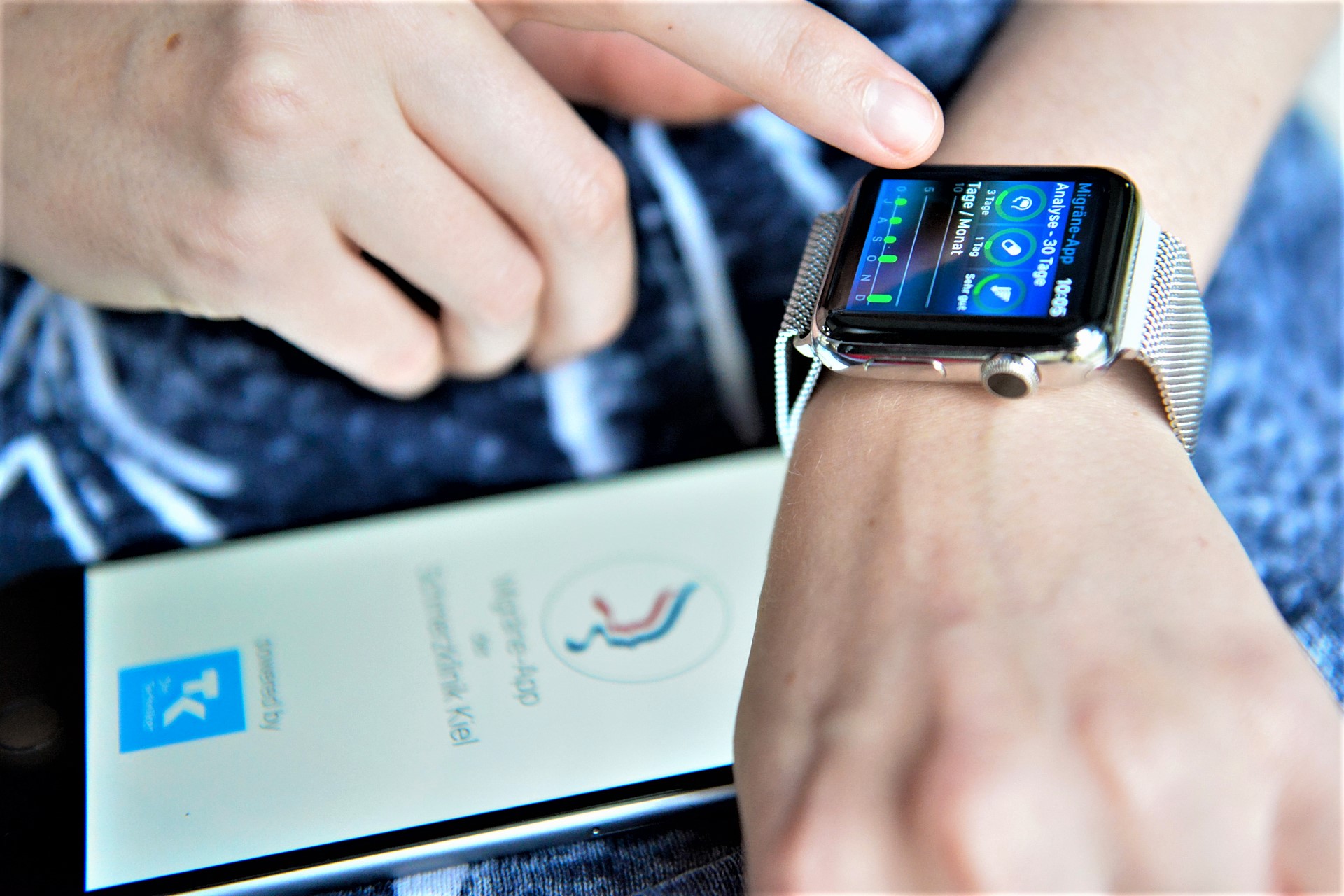
The current issue of the journal Pain Medicine reports on the use of the migraine app in the care of migraine and headache disorders. (Download Migraine App Pain Medicine 05 2020). The migraine app supports patients with chronic headaches by enabling them to digitally document their condition precisely, analyze it with just a few clicks, and monitor it. Table 1 provides an overview of the individual functions and the menu structure. The migraine app provides users with feedback and information from the analyzed data. Based on the entered individual data, it suggests behavioral measures. For example, if the user exceeds the maximum permitted acute medication of no more than nine days per month, they receive a warning. Patients also have access to comprehensive information and self-help tools. These allow them, among other things, to determine and reduce their risk of developing chronic headaches, find a nearby pain specialist using a navigation tool, or practice progressive muscle relaxation in various forms under guidance. In expert live chats, they can ask headache specialists questions and receive helpful answers.
Using the migraine app requires an informed patient who can differentiate their headache type in everyday life. Since the patient also needs to know which acute therapy or other treatment measures to use for each headache type, distinguishing the headache phenotype is a prerequisite for professional treatment. Therefore, the digital healthcare application does not need to prospectively collect all characteristics of the headache phenotype for every attack. The patient enters the relevant characteristics in the "Quick Entry" menu and documents the severity, duration, type of acute medication used, and its effectiveness. At the same time, they document the impact of the headaches on work, school or university, household chores, and social and leisure activities. The migraine app progressively records the degree of impact on these areas. A reduction in activity of more than 50% is documented for recording the degree of impairment caused by headaches. The migraine app also records whether the activity is completely impossible in the respective area due to the headaches. If this affects work, school, or studies, a day of sick leave is recorded. If activities at home or during leisure time are completely impossible, this is documented as 100% impairment. The days of impairment due to headaches are totaled per month and displayed in the last column as GdBK points, representing the degree of impairment caused by headaches . This provides both the patient and doctor with a direct quantitative picture of the impact of headaches in the respective month. This score is calculated analogously to the MIDAS score. The MIDAS score retrospectively records the corresponding impairments for a three-month period from memory. It is evident that the value obtained in this way is significantly more prone to error. In contrast to the MIDAS score, the data for determining the GdBK are collected continuously and prospectively, so its reliability is considered higher.
The direct analysis of the collected progress parameters can be used directly for treatment decisions. A significant reduction of at least 50% in migraine days per month can operationally demonstrate the effectiveness of a chosen headache prophylaxis. The treating physician can then directly determine whether, for example, the chosen medication is effective or whether a treatment adjustment is necessary, such as increasing the dose or changing the medication.




Leave a comment