
 As part of the Day of Action Against Pain, the German Pain Society eV is calling on clinics and pain therapy facilities on Tuesday, June 5, 2012 to bring the central health issue of pain therapy more to the public. The Kiel Pain Clinic , Heikendorfer Weg 9-27, is offering a public information event for those affected and interested parties on Tuesday, June 5, 2012 at 7 p.m. on the topic of “Successful against migraines and headaches”. From 6 p.m. to 7 p.m., those affected can ask questions to experts at the pain clinic on the telephone hotline 0431-20099400. The day before, Monday June 4th, 2012, questions can be directed to Prof. Göbel live chat on Headbook from 6 p.m. These will be answered directly. For this you need to register in Headbook . hands-on workshop on migraine and headache therapy will be held for doctors at the Kiel Pain Clinic. By establishing the first “Day of Action against Pain”, the German Pain Society eV, as well as the partners and participating clinics, want to make an important contribution to improving the situation of pain patients and their relatives in Germany.
Chronic headaches and facial pain are the most common diseases. In Germany, 54 million people report headaches as a serious health problem over the course of their lives. Every year, more than 3 billion individual doses of painkillers are taken nationwide through self-medication alone, an estimated 85% of them for headaches. In Germany, over 125 million packs of painkillers and migraine medications are distributed every year. Including self-medication, around 200 million packs of painkillers were purchased. Of the 20 best-selling medicines in Germany, there are ten preparations for the indication headache alone. The numbers are increasing every year. The amount of painkillers consumed in Germany each year is enough to provide over 10 million Germans with a continuous daily supply of painkillers for an entire year. It is estimated that of the approximately 30,000 dialysis patients, around 20 to 30% required dialysis because of excessive consumption of painkillers. These side effects of pain treatments alone burden statutory health insurance with around 300 million euros annually and contribute significantly to the continuous increase in costs.
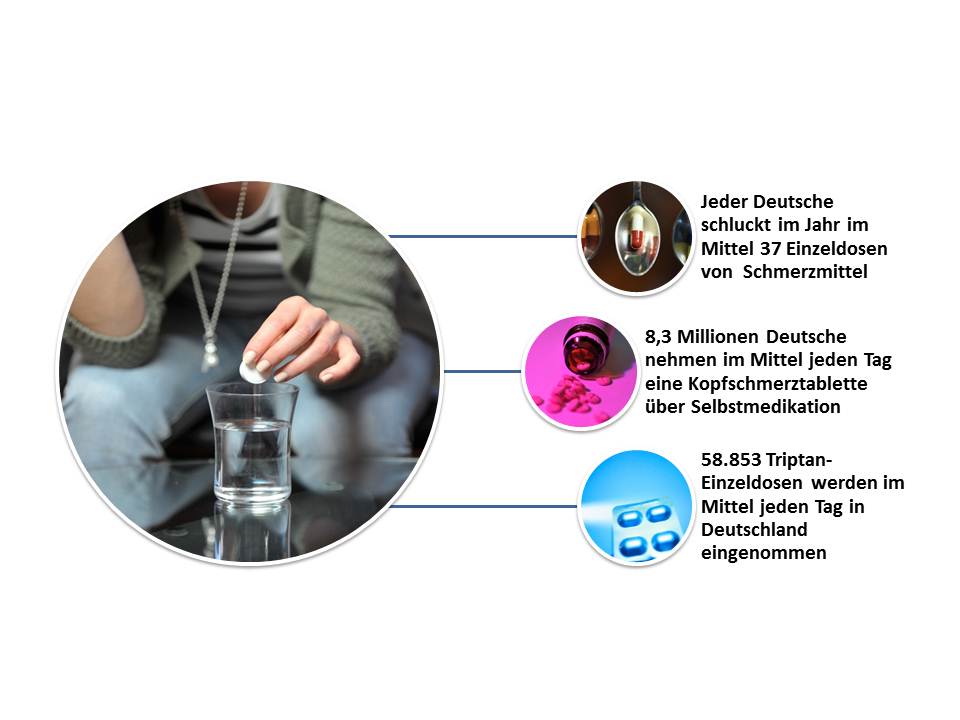
Every German swallows an average of 37 single doses of painkillers every year. On average, 8.3 million Germans take a headache tablet every day through self-medication. 58,853 individual doses of triptan – these are special migraine medications – are taken every day in Germany. Around 60% of the population regularly takes headache medication every month through self-medication. Approximately 12% of the population uses headache medication more than 10 days per month. Around 3% of the population takes migraine and painkillers every day.
Almost 65% of those affected do not consult a doctor but instead treat their headaches independently through self-medication outside of the professional medical system. Only about 15% see a doctor for headache treatment.
The frequency and high cost of neurological pain diseases mean that headache diseases are one of the three neurological diseases with the greatest socio-economic impact, after dementia and stroke. Of all brain diseases, headaches were the most common disease group in Europe, with 152.8 million people affected in 2010. They involve around 9 billion euros in direct costs for services related to the prevention, diagnosis and treatment of headaches, such as doctor consultations, hospital stays and medication. In addition, there are another 34.5 billion euros in indirect costs, such as reductions in work productivity, incapacity to work, etc. In total, headaches cause 43.5 billion in direct and indirect costs in Europe every year.
The World Health Organization and the global campaign against headaches “Lifting the Burden” published an atlas on the prevalence of headache disorders and resources for care in 2011. The main messages of this key WHO publication on the subject of headache describe the current care situation and the necessary steps to modernly improve the diagnosis and treatment of headache disorders:
- Headache disorders are very widespread and severely disabling worldwide. Nevertheless, they are not adequately recognized in health systems, are incompletely diagnosed and inadequately treated;
- Only a minority of people who suffer from headache disorders are adequately diagnosed professionally and treated appropriately;
- Treatment guidelines are routinely used in only 55% of countries;
- Although there is a wide range of therapies that can be used effectively against headaches, adequate medicines for treatment are not made available regardless of per capita income, thereby creating a barrier to contemporary treatment;
- In the training of medical students worldwide, only 4 hours are dedicated to headache disorders; a lack of training is seen as a key problem for the later adequate care of headache disorders;
- Although headache disorders can be diagnosed and alleviated with modern options, due to the lack of use of resources, there is a heavy individual burden for headache sufferers as well as a burden on society. This situation exists senselessly despite treatment options;
- The financial impact for the individual affected, as well as for society due to reduced productivity, is extremely high.
- Suggestions for an improved care landscape include better professional education and training as the most important measure for the care of headache disorders and improved organization and coordination of the care landscape for headaches;
- Given the very high indirect costs of headache disorders, greater commitment to healthcare for headache disorders is required. This measure can also be effective in saving costs overall.
Joint commitment can overcome previous hurdles and create solutions. , experts from the Kiel Pain Clinic created a completely new nationwide coordinated treatment for those seriously affected in collaboration with regional and national health insurance companies A nationwide expert network of doctors has been established with a focus on migraine and headache treatment. These local experts can be consulted directly regionally in order to receive specialized pain therapy close to home. The nationwide headache treatment network and its network partners are continuously trained and receive direct training on the new possibilities of international scientific findings for pain treatment. If it becomes apparent that problems that are difficult to treat cannot be adequately treated regionally, patients have the option of receiving highly intensive treatment nationwide in the neurological-behavioral medicine pain clinic in Kiel due to the care contracts concluded with almost all major health insurance companies. The affected patients can then continue to receive continuous, coordinated care across sectors and disciplines in order to stabilize the treatment effect.
The nationwide headache treatment network was named Germany's best integrated care project in 2012. The important criteria for the price are high-quality medical care and guaranteed benefits for patients, as well as the exemplary networking of previously separate specialized practices and clinics.
Press contact: Prof. Dr.
Hartmut Göbel Tel: 0431-20099150
hg@ pain clinic.de
https:// pain clinic.de
Current new book releases from the Kiel Pain Clinic on the topic:
- Successful against headaches and migraines; Springer-Verlag Heidelberg, 2012, 6th edition
- The headache; Springer-Verlag Heidelberg, 2012, 3rd edition
- Migraine; Springer-Verlag Heidelberg, 2012
This press release can be accessed at https://krebsklinik.de/ueber-uns/presse/ .




Leave a comment