


By far the most common cause of migraine occurring on 15 or more days per month, or of a mixed picture of migraine and tension-type headache with 15 or more headache days per month, is overuse of specific acute migraine medications or painkillers [7, 8].
Generally, medication overuse is defined in the number of days the medication is taken per month. Crucially, the medication must be taken regularly , meaning on several days per week. If the limit is, for example, 10 days per month, this would mean an average of 2-3 days of medication use per week. If a cluster of medication-taking days is followed by longer periods without medication of at least three days, the likelihood of developing headaches due to medication overuse is significantly lower.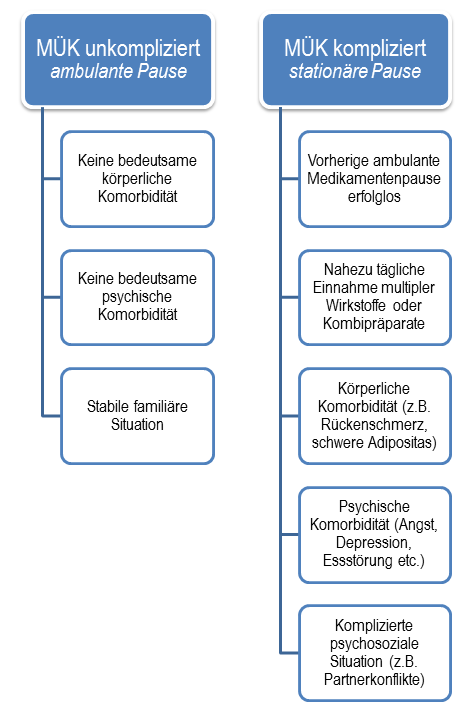
Furthermore, headaches resulting from medication overuse often have the characteristic of switching between migraine and tension-type headache features, even within a single day, thus creating a new headache type. This was formerly termed "combination headache," but this term is not defined and should therefore be avoided. Diagnosing medication overuse headache is crucial because patients typically do not respond to headache prophylaxis while overusing medication.
The general criteria for medication overuse headache (MOH) are now internationally defined in the International Classification of Headache Disorders (ICHD-3beta). The development of this serious and frequent complication in the treatment of primary headaches is becoming increasingly better understood thanks to new studies.
Cerebral imaging studies have identified structural and functional changes in the brains of patients with medication overuse headache (MOH). Current data demonstrate functional changes in intrinsic neural networks, but not macrostructural changes. Addiction processes appear to play a prominent role in the development and maintenance of MOH [ 1 ]. The frequency of medication use per month is a crucial significant prognostic factor for the development and maintenance of MOH [ 3 , 12 ]. Relapse rates are correlated with psychological decision-making processes, particularly with elevated dependence scores [ 12 ].
Further recent studies on the development of medication overuse headache (MOH) have consistently documented sensitization and increased excitability of trigeminal and cortical neurons [ 9 , 16 , 17 , 18 , 19 ]. Cortical hyperexcitability appears to promote the development of cortical spreading depression, which is considered a correlate of migraine aura. Peripheral and central hypersensitivity also appear to be increased.
This alteration is thought to be based on serotonergic (5-HT) and possibly endocannabinoid-mediated mechanisms. The expression of excitatory cortical 5-HT2A receptors could increase the likelihood of cortical spreading depression activation. Depletion of central pain defense systems can activate the process of central sensitization and further stimulate other molecular processes of hyperexcitability. Reduced 5-HT levels can increase the expression and release of calcitonin gene-related peptide (CGRP), further enhancing the sensitization of trigeminal neurons.
Exhaustion of the central pain-modulating systems as a consequence of chronic medication overuse thus leads directly to a gradually increasing sensitization of pain perception and continuously results in an increase in the frequency of analgesic use, which in turn leads to further sensitization. Without interruption of this feedback loop, an open-ended, perpetual cycle can develop [ 9 , 16 , 17 , 18 , 19 ]. This is precisely the development that can be observed in clinical practice [ 3 ].
The mechanisms described do not only affect pain perception. Other aspects of experience and behavior are also influenced. These include depression, anxiety, inner restlessness, sleep disturbances, increased irritability, lack of energy, exhaustion, social withdrawal, and others. Experience and behavior become focused on the pain and the frustrating attempts at treatment. These pathophysiological mechanisms explain why the effectiveness of preventive migraine medications is negated when medication overuse headache (MOH) is also present. It is pointless to aim for a reduction in hypersensitization with prophylactic medication while simultaneously perpetuating the underlying cause of this hypersensitization, namely medication overuse [ 3 , 11 ]. Similarly, it is not advisable to expect a stable situation with continuous triptan use. Sensitization will progressively worsen and, over time, decompensate, escalating the situation.
Therefore, there is only one solution for sustainable therapy: the continuous intake of medication must be stopped, and a medication break or, in the case of substances that must no longer be used, medication withdrawal must be observed [ 4 , 5 , 6 , 15 , 20 , 21 ]. The goal is to allow the exhausted body's own pain defense system to recover and to normalize pain sensitivity. As long as continuous overuse persists, no treatment method can achieve a significant and lasting improvement. There is no fundamental solution to the problem other than a controlled and systematic break from taking pain medication [ 3 , 7 , 8 , 11 ].
If simply informing and instructing the patient does not lead to the cessation of medication overuse, a medication break or withdrawal treatment is necessary. This can be carried out on an outpatient, day-clinic/partial inpatient basis, or inpatient basis. In uncomplicated cases, the results do not differ depending on the chosen organizational form. In complicated cases, inpatient withdrawal treatment within the framework of a multimodal treatment concept is significantly superior2, 10, 11, 13, 14, 16]
literature
1. Chanraud S, Di Scala G, Dilharreguy B et al. (2014) Brain functional connectivity and morphology changes in medication-overuse headache: Clue for dependence-related processes? Cephalalgia: an international journal of headache
2. Creac'h C, Frappe P, Cancade M et al. (2011) In-patient versus out-patient withdrawal programs for medication overuse headache: a 2-year randomized trial. Cephalalgia: an international journal of headache 31:1189-1198
3. Göbel H (2012) The Headaches. Springer, Berlin, Heidelberg, New York, London, Paris, Tokyo, Hong Kong, Barcelona, Budapest
4. Hagen K, Albretsen C, Vilming ST et al. (2011) A 4-year follow-up of patients with medication-overuse headache previously included in a randomized multicenter study. The journal of headache and pain 12:315-322
5. Hagen K, Linde M, Steiner TJ et al. (2012) Risk factors for medication-overuse headache: an 11-year follow-up study. The Nord-Trondelag Health Studies. Pain 153:56-61
6. Hagen K, Stovner LJ (2011) A randomized controlled trial on medication-overuse headache: outcome after 1 and 4 years. Acta neurologica Scandinavica. Supplement:38-43
7. Headache Classification Committee of the International Headache S (2013) The International Classification of Headache Disorders, 3rd edition (beta version). Cephalalgia: an international journal of headache 33:629-808
8. Headache Classification Subcommittee of the International Headache S (2004) The International Classification of Headache Disorders: 2nd edition. Cephalalgia: an international journal of headache 24 Suppl 1:9-160
9. Le Grand SM, Supornsilpchai W, Saengjaroentham C et al. (2011) Serotonin depletion leads to cortical hyperexcitability and trigeminal nociceptive facilitation via the nitric oxide pathway. Headache 51:1152–1160
10. Munksgaard SB, Bendtsen L, Jensen RH (2012) Detoxification of medication-overuse headache by a multidisciplinary treatment program is highly effective: a comparison of two consecutive treatment methods in an open-label design. Cephalalgia: an international journal of headache 32:834-844
11. Olesen J (2012) Detoxification for medication overuse headache is the primary task. Cephalalgia: an international journal of headache 32:420-422
12. Radat F, Chanraud S, Di Scala G et al. (2013) Psychological and neuropsychological correlates of dependence-related behavior in Medication Overuse Headaches: a one year follow-up study. The journal of headache and pain 14:59
13. Rossi P, Di Lorenzo C, Faroni J, et al. (2006) Advice alone vs. structured detoxification programs for medication overuse headache: a prospective, randomized, open-label trial in transformed migraine patients with low medical needs. Cephalalgia: an international journal of headache 26:1097-1105
14. Rossi P, Faroni JV, Nappi G (2008) Medication overuse headache: predictors and rates of relapse in migraine patients with low medical needs. A 1-year prospective study. Cephalalgia: an international journal of headache 28:1196-1200
15. Shah AM, Bendtsen L, Zeeberg P et al. (2013) Reduction of medication costs after detoxification for medication-overuse headache. Headache 53:665–672
16. Srikiatkhachorn A, Le Grand SM, Supornsilpchai W et al. (2014) Pathophysiology of medication overuse headache-an update. Headache 54:204–210
17. Supornsilpchai W, Le Grand SM, Srikiatkhachorn A (2010) Cortical hyperexcitability and mechanism of medication-overuse headache. Cephalalgia: an international journal of headache 30:1101-1109
18. Supornsilpchai W, Le Grand SM, Srikiatkhachorn A (2010) Involvement of pro-nociceptive 5-HT2A receptor in the pathogenesis of medication-overuse headache. Headache 50:185–197
19. Supornsilpchai W, Sanguanrangsirikul S, Maneesri S et al. (2006) Serotonin depletion, cortical spreading depression, and trigeminal nociception. Headache 46:34-39
20. Usai S, Grazzi L, Andrasik F et al. (2004) Chronic migraine with medication overuse: treatment outcome and disability at 3 years follow-up. Neurological sciences : official journal of the Italian Neurological Society and of the Italian Society of Clinical Neurophysiology 25 Suppl 3:S272-273
21. Usai S, Grazzi L, D'amico D et al. (2008) Reduction in the impact of chronic migraine with medication overuse after day-hospital withdrawal therapy. Neurological sciences : official journal of the Italian Neurological Society and of the Italian Society of Clinical Neurophysiology 29 Suppl 1:S176-178[/fusion_builder_column][/fusion_builder_row][/fusion_builder_container]




Leave a comment