



Generations of students have grappled with the problem that a word can have different genders in different languages. The assignment to feminine, masculine, or neuter often seems rather arbitrary. A typical example is pain. dolore douleur both dolor (m.) – only the former is masculine and the latter feminine! Even in geographically neighboring languages like Spanish and Portuguese, there is no agreement: the Spanish dolor is masculine, while the Portuguese dor is feminine. Even in antiquity, there was disagreement. Unlike the Latin dolor, ἄλγος (algos) in Ancient Greek was neuter! If pain is sometimes assigned to the feminine, sometimes to the masculine, and sometimes to neither gender in different languages, this may simply reflect the experience that both genders can equally feel pain. It is all the more astonishing how uniformly migraine (hemicrania, emicrania, migraine, migraña, enxaqueca, or jaqueca) is feminine in different languages. In the judgment of various cultures, migraine is apparently predominantly a disease of women.
The question of whether this is actually the case can be approached epidemiologically. Representative population samples do indeed show a predominance of the female sex by a factor of 2-3 over the entire lifetime (1). Before the age of 12, there is little difference between the two sexes. Among younger children, boys are even slightly more frequently affected. This changes with the onset of puberty. The abrupt drop in estrogen levels before menstruation is a potent trigger for migraine attacks in many women (2). It makes little difference whether this is due to natural hormonal fluctuations or estrogen withdrawal during the "pill-free interval" when taking estrogen-containing contraceptives (3). In women, the drop in hormones is often the sole trigger. This female-specific menstrual migraine is likely the main reason why migraine occurs more frequently in women than in men, but also why migraine is perceived as a female disease.
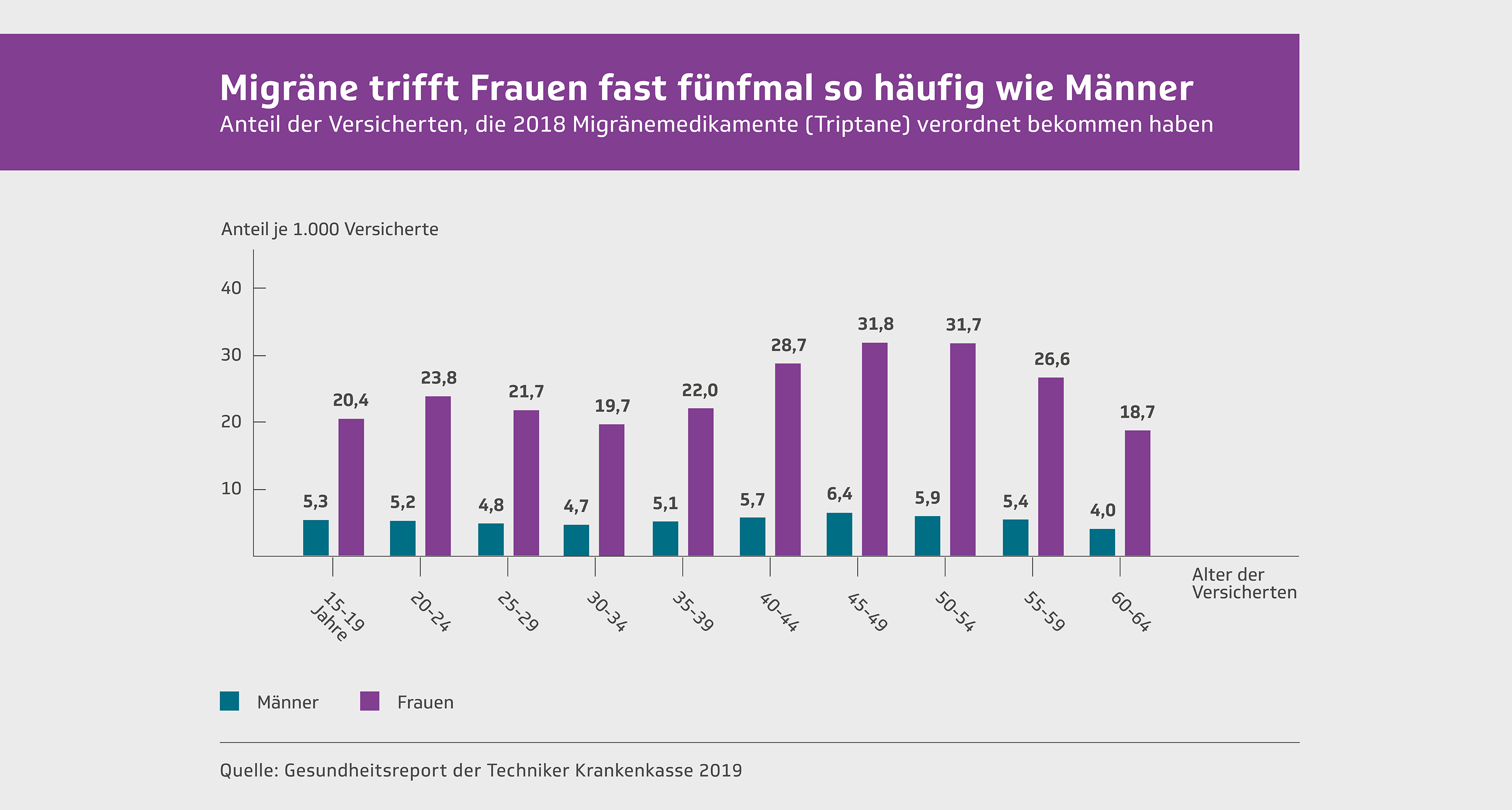
However, there is a difference between the sexes not only in the frequency of migraine but also in the severity of the condition. This becomes clear when analyzing health insurance data regarding healthcare utilization. Such an approach allows us to determine how many people suffer from their migraines to such an extent that they also incur costs. Data for Germany is provided by the 2017 BARMER Physician Report, which focuses on headaches (4). According to this report, in 2015, a total of 2.1% of men received medical treatment for migraine, while the figure for women was 6.8%, or 3.2 times higher. Among 24-year-olds and 50-year-olds, as many as one in ten women were affected. 4.3 times more women than men were prescribed triptans – specific migraine medications that are only used when other painkillers are no longer sufficiently effective. Women, therefore, require more frequent and intensive medical treatment than would be expected based solely on prevalence. Migraine is evidently more severe in women. This is further supported by the fact that women consistently make up a disproportionately high 80 to 85% of patients in clinical migraine studies (5, 6). There is a high level of suffering and clearly an unmet need for new treatment options. (Katja Heinze-Kuhn, Axel Heinze and Hartmut Göbel).
Literature:
- Merikangas KR. Contributions of epidemiology to our understanding of migraine. Headache. 2013;53(2):230-46.
- Marmura MJ. Triggers, Protectors, and Predictors in Episodic Migraine. Curr Pain Headache Rep. 2018;22(12):81.
- Silberstein SD. Sex hormones and headaches. Rev Neurol (Paris). 2000;156 Suppl 4:4S30-41.
- Grobe T, Steinmann S, Szecsenyi J. BARMER Medical Report. Series on Health Analysis, Volume 1: BARMER Head Office, Asgard Verlagsservice GmbH; 2017.
- Reuter U, Goadsby PJ, Lanteri-Minet M, Wen S, Hours-Zesiger P, Ferrari MD, et al. Efficacy and tolerability of erenumab in patients with episodic migraine in whom two-to-four previous preventive treatments were unsuccessful: a randomized, double-blind, placebo-controlled, phase 3b study. Lancet. 2018;392(10161):2280-7.
- Skljarevski V, Matharu M, Millen BA, Ossipov MH, Kim BK, Yang JY. Efficacy and safety of galcanezumab for the prevention of episodic migraine: Results of the EVOLVE-2 Phase 3 randomized controlled clinical trial. Cephalalgia. 2018;38(8):1442-54.




Leave a comment