


The causes of migraines – the most important theories
causes
This section will not only offer you a brief glimpse into the history of migraine research. Its primary purpose is to provide you with an overview of the current state of migraine research. This is not merely of academic interest. The reason we continue our research is far more practical: only by understanding the causes in detail can we develop therapies that target the root causes directly and eliminate the pain with minimal side effects.
What people thought back then
Headache disorders, including migraines, are as old as humanity itself. The earliest evidence dates back to around 6,000 BC. It is possible that the so-called trepanations—holes carved into the skull—were intended to allow the painful, evil spirit to escape. Not everyone would have survived this brutal therapy. However, numerous skulls have been found where the bone edges have grown back together, indicating that the "patients" must have survived. The treatment with leeches to draw out toxins, which is still practiced by some alternative practitioners today, is based on precisely these ancient ideas.
Of evil spirits and “nerve storms”
The Sumerians, 4,000 years ago, considered migraines the work of evil spirits and recommended prayers to the god Horus as a treatment. The Greek physician Aretaeus of Cappadocia (1st century BCE) believed migraines were caused by colds and dehydration. Other supposed explanations that accumulated in antiquity and the Middle Ages included: sensory overload, an overabundance of bile in the stomach and intestines, and an imbalance of the four humors: blood, black bile, yellow bile, and phlegm.
While the British physician Thomas Willis recognized as early as the 17th century that a narrowing or dilation of blood vessels is a contributing factor in the development of migraines, concepts resurfaced in the 19th century that make us chuckle today. Masturbation, "bad" hereditary influences, infections, eye inflammation, and similar factors were blamed for migraines.
However, one 19th-century work was truly groundbreaking, providing not only an insightful overview of the milestones in the history of ideas concerning the origins of migraines, but also containing the explanatory concepts still valid today: Edward Liveing's 1873 book, "On Migraine, Sick-Headache, and Some Allied Disorders." In this work, Liveing discusses, among other things, the theory of circulatory disorders as a cause of migraines and also introduces a new theory: migraines as a consequence of "nerve storms"—excessive discharges of cranial nerves. How far ahead of his time Liveing was can be seen in the fact that medical professionals still sometimes debate whether changes in the blood vessels or changes in the nervous system ("nerve storms") are the primary cause of migraines.
Migraine pain put to the test
If we step on a thumbtack barefoot, we know what to expect: It hurts sharply at first, then more of a dull, burning sensation. Most of us are also familiar with the feeling of a calf cramp or a sprained joint: equally unpleasant.
These two types of pain are referred to as "somatic pain." If it originates in the skin (e.g., from a thumbtack), it is called "superficial pain." If it originates in the muscles, joints, bones, or connective tissues, it is called "deep pain.".
If we want to know where we stepped on a thumbtack, we have no trouble finding the injured spot – the pain is easily localized. We also immediately locate the source of pain from a calf cramp or a sprained joint. This is quite different with so-called "visceral" pain.
Hide-and-seek of pain
Thalamic infarction
“Viscera” is Latin and, according to the Duden dictionary, refers to the “organs located inside the skull, chest, abdominal, and pelvic cavities.” Pain originating in or around these organs is also commonly called “visceral pain” or, medically, “internal pain.” This definition makes it quite clear what we are talking about: for example, the pain of appendicitis, biliary or intestinal colic, pleurisy, or even a heart attack.
Visceral pain has three typical characteristics: it often radiates to sometimes distant areas of the skin or muscles, it leads to excessive pain sensitivity of the affected organ system and/or the area of skin to which the pain radiates, and visceral pain is particularly often accompanied by autonomic symptoms such as sweating, paleness, increased blood pressure, muscle tension, nausea and/or vomiting.
We find these signs, for example, in an acute heart attack: The severe and excruciating pain in the heart behind the breastbone often radiates to the shoulders (especially the left) and the left arm. However, the pain can also be localized in the jaw, the upper abdomen, or the back between the shoulder blades. The organ itself, as well as the affected skin areas, are extremely sensitive to pain, and the complexion is pale and ashen. Nausea and vomiting are common, along with cold sweat on the forehead and upper lip, and there may even be a sudden circulatory collapse.
Qualities of migraine pain
Although brain surgery inevitably involves some degree of damage to brain tissue, anesthesia is generally unnecessary. The reason: brain tissue is insensitive to pain. Given the excruciating headaches of migraines, this statement seems, to say the least, strange. Apparently, something happens during a migraine attack that makes the otherwise pain-insensitive structures of the brain extremely sensitive. We will attempt to define this "something" more precisely in the following sections.
But first, let's focus on the pain itself and its characteristics. Until recently, migraine was described as deep pain. Today, we know that the term "internal pain" is far more fitting. This is because migraine pain, like any other condition, is often difficult to pinpoint and radiates to distant areas – in the case of migraines, usually the neck muscles. Furthermore, it has been shown that migraine pain can be accompanied by numerous autonomic symptoms: nausea and vomiting, sensitivity to light and sound, pale skin, chills, shivering, and much more.
Migraine as a circulatory disorder?
There are several reasons why changes in blood flow to the brain – i.e., too much or too little pressure in the blood vessels – might be suspected as a cause of migraines:
- The migraine headache is throbbing and intensifies with each heartbeat.
- Headaches also occur with other disorders of the blood vessels in the brain – e.g., stroke, high blood pressure or inflammation of the blood vessels.
- The brain itself is not sensitive to pain. However, the blood vessels of the brain are.
- Certain medications, called triptans, which affect the diameter of the blood vessels in the brain and thus blood flow, can effectively stop a migraine attack.
- During the aura phase, reduced blood flow is observed in the cerebral cortex, specifically in the area at the back of the head. Interestingly, this area is responsible, among other things, for vision. And as you already know, aura symptoms are usually visual in nature.
A side effect, not the cause
At first glance, the connections between changes in blood flow in the brain and migraines seem quite plausible: each of the five points is absolutely correct on its own. However, the conclusion that migraines are a purely vascular (in the blood vessels) based disease is still unlikely.
Let's take a closer look at point 5. The fact that the reduced blood flow mentioned during the aura occurs is beyond question. It has been proven using numerous methods. However, if we examine the pattern of cerebral blood flow in different forms of migraine – with and without aura – we immediately see that this cannot be the explanation for the migraine itself. In migraine without aura, there is no change in blood flow in the head whatsoever. Therefore, migraine pain cannot be related to blood flow, even though points 1 to 4 mentioned above seem to provide strong indications.
But what about the aura? Is it at least triggered by the changes in blood flow? Even that isn't clear. Whether it can be responsible depends on the extent of the reduced blood flow in the affected brain area. If it is indeed 50 percent – as proponents of the so-called vascular hypothesis claim – then an oxygen deficiency would occur in the brain cells, which could certainly lead to the aura symptoms. If, on the other hand, the blood flow drops by a maximum of 25 percent – as advocates of the neurogenic (caused by nerves) hypothesis assume – this would not be sufficient to explain the effects.
Regardless of how the discussion ultimately turns out, changes in the diameter of blood vessels in the brain cannot be considered the primary cause of migraines. No matter the extent of these changes in blood flow, we should only consider them as accompanying symptoms.
Migraine as inflammation?
If we injure ourselves on a thorn while gardening and foreign bodies such as bacteria may have entered the wound, or if we have lain in the sun for too long without protection, the typical signs of inflammation appear: The affected area reddens, swells, becomes hot and painful.
In both cases (thorns, sunburn), body tissue is damaged, and the subsequent inflammatory response is simply the body's normal way of repairing the injury. This process releases messenger substances (so-called inflammatory mediators) that increase blood flow to the area (redness), make blood vessels more permeable so that more immune cells and tissue fluid can leak out (swelling), accelerate metabolism at the site of the injury (heat), and increase pain sensitivity. It is therefore a beneficial process that, on the one hand, creates the conditions for the necessary repairs and, on the other hand, warns us through pain against putting further strain on the injured area.
Special case of neurogenic inflammation
However, an inflammatory response can also be triggered by nerves – hence the term “neurogenic inflammation” – without tissue damage or bacterial infection. In this case, increased nerve activity triggers the release of inflammatory mediators. As with any other inflammation, these cause increased blood flow in the blood vessels of the meninges, making the vessels more permeable and increasing pain sensitivity in the area. Applied to migraines, the neurogenic inflammation model can explain why the blood vessels in the brain are so sensitive to pain that the pain intensifies with each heartbeat.
Partial explanation yes, cause no
It is certain that neurogenic inflammation is an important mechanism for the body to defend against damage. However, it is uncertain whether it actually plays a significant role in migraines. Nevertheless, the concept of neurogenic inflammation offers plausible explanations for some aspects of migraines, which is why it holds considerable importance in modern migraine models. However, neurogenic inflammation is certainly not the cause of migraines in the sense of a factor X that provides answers to all our open questions.
Brain under high tension
Sudden changes in one's normal daily routine are particularly effective triggers for migraine attacks. It appears that these changes cause a temporary disruption of the normal flow of information. It is a significant achievement of the Belgian migraine researcher Jean Schoenen and his colleagues to have demonstrated this heightened susceptibility to altered sensory processing through laboratory measurements in 1984. These measurements involve a specific type of brainwave recording, an electroencephalogram (EEG), during which patients must pay attention to and react to specific stimuli.
Get ready to hit the gas
What is being investigated under laboratory conditions is something we know well from everyday life: A driver has to stop at a red light. He has no idea how long the light has been red and therefore doesn't know exactly when the yellow phase will begin. He thus remains in a state of moderate readiness and attentively observes whether the light changes. As soon as the light turns yellow, the driver knows that green will follow in a few seconds and that he then has to release the clutch and accelerate. The driver is now particularly focused, mentally preparing for his task and carrying it out immediately after the light turns green. During the phase of heightened readiness directly before the action is performed, the brain must be especially active: It has to pre-plan the action so that it can be carried out immediately, and it has to take an internal clock into account to estimate the time interval between the yellow and green phases.
Migraine patients think differently
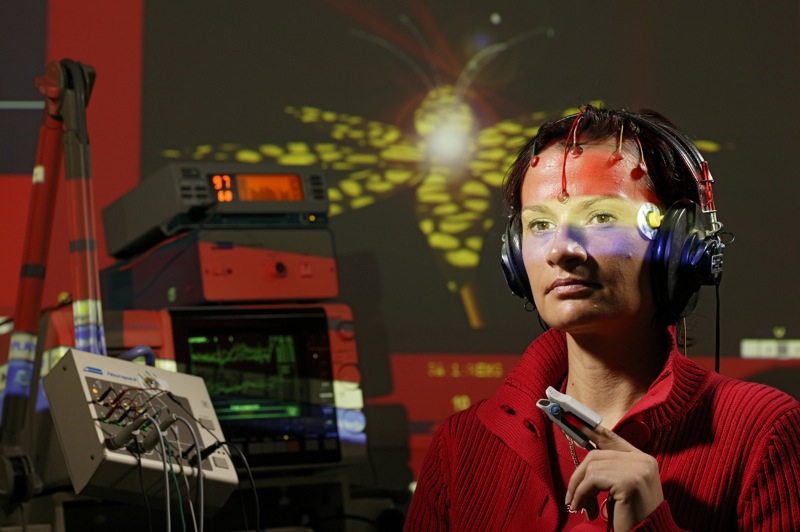
This particular readiness can now be visualized in an EEG. Of course, you don't set up traffic lights in the lab. But the principle is the same. Typically, the procedure involves the patient, connected to the EEG, wearing headphones and a pair of glasses with built-in lights. The patient is told that, for example, three seconds after a signal (such as a short click) is heard in the headphones, the light in the glasses will illuminate. As soon as this light signal appears, the patient should press a button.
To obtain meaningful results, this process is usually repeated at least 30 times. The interval between individual measurements varies in length, so the patient never knows exactly when the next stimulus will occur. The individual measurements are averaged using a computer, and the magnitude of the electrical voltage shift in the EEG can be determined very precisely based on these average values.
It turns out that the brains of migraine patients react differently to such tasks than the brains of healthy individuals or people with other types of headaches. Two abnormalities are apparent:
- The voltage shift in the EEG – i.e., the zigzag lines on the paper or monitor – is significantly larger than in other people.
- While in healthy individuals the voltage shift decreases after several measurements, it remains high in migraine patients.
These measurements provide important evidence that the brains of migraine patients are clearly particularly active in responding to stimuli. But that's not all: While in healthy individuals attention gradually diminishes with repeated exposure to stimuli, the brain of a migraine patient remains constantly in a state of maximum alert. The brain apparently cannot "switch off" and is, quite literally, always on high alert. Interestingly, successful treatment of these patients with migraine-preventive medications—so-called beta-blockers—can normalize this altered electrical behavior of the brain.
Practical: Modern model of migraine development
Migraine researchers have amassed a wealth of knowledge over the past 100 years. The numerous individual findings—including, among many others, the aforementioned facts regarding the vascular theory, neurogenic inflammation, and the excessive brain activity in migraine sufferers—are astonishing. However, this accumulation of knowledge also presents a major problem: the sheer volume of data makes understanding the underlying processes increasingly difficult.
It is clear that migraines are not caused by a single factor. However, I would like to offer you a theory that incorporates as much of the available data as possible. Although many assumptions of this migraine theory are not yet fully supported by research data, this model can place a number of individual findings into a meaningful relationship with one another. I call it the "Neurological-Behavioral Migraine Theory.".
The onset of the migraine attack
According to this migraine theory, migraine sufferers have an innate peculiarity in the way their brains process stimuli – they are constantly in a state of "high tension." If certain triggering factors occur too quickly, too suddenly, for too long, or too intensely, a cascade of sometimes simultaneous physiological changes is set in motion in the migraine sufferer, ultimately resulting in a migraine attack. The trigger factors are, in a sense, the final straw.
Which trigger factors are decisive in a given situation can only be predicted in a small proportion of patients. Possible triggers include external stimuli such as stress, noise, irregularities in the sleep-wake cycle or daily routine, as well as certain foods. Internal factors can also trigger an attack: changes in hormone levels, hunger, or metabolic changes, for example, due to medication.
Flood of neurotransmitters
The generally heightened brain activity, combined with trigger factor(s), leads to a sudden and excessive activation. Within a very short time, far too many neurotransmitters are released, particularly the mood-regulating hormone (“happiness hormone”) serotonin and other excitatory neurotransmitters. The brain misinterprets this excessive release of neurotransmitters as a reaction to poisoning. The logical consequence is the activation of protective reflexes in the form of nausea and vomiting. However, these reflexes are biologically ineffective, as the excessive activation of neurotransmitters was ultimately triggered not by actual poisoning through food ingestion, but by the overstimulation itself. Vomiting cannot eliminate the excessive concentration of neurotransmitters in the brain. The result is pointless nausea, retching, and vomiting.
The origin of aura symptoms
At the same time, the excessive release of excitatory neurotransmitters can trigger a so-called "spreading depression"—in a region of the cerebrum responsible for processing sensory information. "Spreading depression" essentially means "spreading dampening (of nerve cells)." This is what can produce the aura symptoms in migraine sufferers. The affected brain cells are initially overexcited, only to then enter a state of reduced activity. This disruption of the nerve cells and the associated reduced blood flow spread across the brain region at a speed of three to six millimeters per minute. This is precisely the speed at which the aura symptoms spread. At the front of the spread, the nerve cells fire furiously, only to enter a state of lethargy once the front has advanced. This is most noticeable in the type of aura characterized by paresthesia: The aura begins, for example, with tingling in the fingertips. The tingling sensation travels up the arm to the tongue over the course of 30 to 60 minutes, following the path predetermined by the disrupted brain cells in the cerebral cortex. After the tingling subsides, a numbness often remains, corresponding to the dampened excitation of the brain cells, and this, like the other aura symptoms, eventually disappears.
The pain begins
Spreading depression leads to a disruption in electrolyte concentrations (for example, of the mineral magnesium) within and between cells. As a result, neighboring pain receptors are stimulated and thus enabled to transmit pain signals. It takes approximately 30 to 60 minutes for inflammatory mediators to be released, triggering neurogenic inflammation in the blood vessels of the meninges. Because the inflammation spreads through the blood vessels—and consequently, so does the pain sensitivity—the effects of the inflammation accumulate both spatially and temporally: Migraine pain typically spreads across various areas of the head and increases in intensity over time.
This lasts until the body's compensatory mechanisms kick in. These include the breakdown of neurotransmitters released in increased amounts during the initial phase and the activation of the body's own pain defense systems. It can take several hours, and in some cases up to three days, until these mechanisms are able to correct the dysregulation in the central nervous system.
With or without an aura?
The mechanisms that lead to migraine with or without aura are not yet fully understood. One possible explanation is that the processes described in migraine with aura initially occur much more rapidly, leading to significant changes in blood flow within the central nervous system, which could be responsible for the development of the aura. In contrast, a very slow, gradually developing mechanism might be triggered in migraine without aura. Disruptions in this mechanism might not lead to a noticeable change in blood flow, but could subsequently also release inflammatory neurotransmitters and induce pain in the blood vessels of the meninges.
Radio interference in the brain
The neurotransmitters released in excess at the beginning of an attack must, of course, be broken down again. However, the rapid breakdown of these neurotransmitters leads to a phase of neurotransmitter depletion – the stores of these crucial neurotransmitters are initially depleted and must be replenished. But without neurotransmitters, there is no, or at least no, proper signal transmission in the brain. The result: global information processing in the brain is disrupted.
The brainstem is also affected
The inflammation triggered by the excessive release of neurotransmitters also leads to the activation of nerve centers in the brainstem. This can cause pain to spread to areas of the body that were not initially involved. These include, in particular, the shoulder and neck muscles, as well as areas of the skull not directly affected by the neurogenic inflammation.
This sensory overload could also explain why normally non-painful stimuli are experienced as extremely unpleasant during a migraine attack, particularly in the form of light and noise hypersensitivity. Therapeutic interventions, such as massage, heat applications, or trigger point injections in the head and neck muscles, can reduce the constant subthreshold stimulation in the brainstem and thus be experienced as pleasant by migraine patients, without, however, altering the persistence of the migraine attack. The influence of mental mechanisms on the migraine process—especially cognitions, emotions, the ability to actively influence stimuli (e.g., stress management), and psychological relaxation—can be understood through the activation of the body's own pain control systems.